

In today’s Ethereum landscape, with ETH priced at $2,270.80 after a 24-hour decline of $-72.65 (-3.10%), liquid restaking tokens (LRTs) stand out as precision-engineered tools for amplifying staked ETH liquidity restaking. These tokens encapsulate restaked positions on EigenLayer, letting users capture layered yields from AVSs (Actively Validated Services) without sacrificing capital access in DeFi protocols.

LRTs build on liquid staking tokens (LSTs) like stETH, transforming illiquid restaking into fluid assets. Picture depositing LSTs into an LRT protocol: you receive an LRT such as eETH or ezETH, redeemable for underlying restaked ETH plus accrued rewards. This mechanism, pioneered by EigenLayer, repurposes staked ether to secure rollups, oracles, and beyond, injecting economic security into Ethereum’s modular future.
Core Mechanics Driving LRT Efficiency
At their essence, liquid restaking tokens LRT protocols mint derivative tokens against LST deposits or native ETH. Ether. fi, for instance, wraps stETH into eETH, enabling seamless DeFi participation while the position rests on EigenLayer. Renzo’s ezETH follows suit, optimizing for automated AVS selection to minimize slashing risks. This isn’t mere tokenization; it’s a yield flywheel where LRT holders earn staking rewards, EigenLayer points, and protocol incentives simultaneously.
Consider the liquidity boost: traditional restaking locks funds, but LRTs trade on DEXes, collateralize loans on Aave, or fuel liquidity pools on Uniswap. As TVL in liquid restaking nears $8 billion, per recent data, this composability unlocks trillions in dormant capital. Ether. fi commands over $3.2 billion TVL, Renzo $2 billion, and Puffer Finance $1.3 billion, underscoring protocol maturity amid ETH’s current $2,270.80 valuation.
“LRTs repurpose staked ether to support external systems like rollups and oracles with an economic security layer. ” – CoinDesk on Liquid Restaking Tokens
Yet, precision matters: LRTs aren’t risk-free wrappers. They inherit LST slashing vectors and add EigenLayer-specific exposures, demanding vigilant operator selection. Still, for yield optimizers, the trade-off favors liquidity; charts reveal LRT prices hugging NAVs tightly, signaling robust peg stability even as ETH dips to $2,115.33 intraday lows.
Market Leaders and TVL Dynamics
Ether. fi’s dominance isn’t accidental. Its eETH integrates native restaking with diamond-hand incentives, drawing institutional flows. Renzo counters with ezETH’s multi-LST support, aggregating liquidity from Lido, Rocket Pool, and others. Puffer’s pufETH emphasizes points farming efficiency, while newcomers like Swell’s rswETH layer Ethereum staking atop EigenLayer yields without liquidity locks.
Zoom out: liquid restaking TVL exploded post-EigenLayer mainnet, mirroring LST growth phases but accelerated. At ETH’s $2,270.80 price, LRT protocols capture 10-15% annualized base yields, plus AVS premiums pushing APYs toward 20% in bull scenarios. This positions eigenlayer LRT as DeFi’s next efficiency frontier, where staked positions compound across security layers.
| Protocol | LRT Token | TVL ($B) |
|---|---|---|
| Ether. fi | eETH | 3.2 |
| Renzo | ezETH | 2.0 |
| Puffer | pufETH | 1.3 |
These figures, current as of February 2026, reflect a market maturing beyond hype. LRT derivatives now underpin L2 bridges and oracle networks, fortifying Ethereum’s security budget.
Explore how LRTs unlock layered yields in this space.
Yield Layering and Risk Calibration
Diving deeper, LRTs excel in yield stacking: base ETH staking (3-4%), EigenLayer restaking (variable AVS rewards), and protocol emissions. At ETH $2,270.80, a $10,000 eETH position might net $1,500 annually, assuming 15% APY, all while tradable. But calibration is key; overexposure to correlated AVSs amplifies drawdowns.
Ethereum (ETH) Price Prediction 2027-2032
Forecasts incorporating the impact of Liquid Restaking Tokens (LRTs) like eETH (Ether.fi), ezETH (Renzo), and pufETH (Puffer Finance) on ETH liquidity and yields, based on $2,270 baseline in 2026
| Year | Minimum Price (USD) | Average Price (USD) | Maximum Price (USD) |
|---|---|---|---|
| 2027 | $2,800 | $4,200 | $6,500 |
| 2028 | $3,500 | $5,500 | $9,000 |
| 2029 | $4,500 | $7,200 | $12,000 |
| 2030 | $6,000 | $9,500 | $16,000 |
| 2031 | $8,000 | $12,500 | $21,000 |
| 2032 | $10,000 | $16,000 | $27,000 |
Price Prediction Summary
ETH prices are projected to rise significantly from 2027-2032, driven by LRT adoption boosting staked ETH liquidity and DeFi yields. Bullish max scenarios reflect TVL growth beyond $8B and EigenLayer expansion, while min prices account for bearish risks like regulation and volatility. Average prices show ~30% CAGR, reaching $16K by 2032.
Key Factors Affecting Ethereum Price
- Rapid LRT TVL growth (Ether.fi $3.2B, Renzo $2B, Puffer $1.3B in 2026)
- EigenLayer restaking enabling multi-layer yields and L2/oracle security
- Ethereum scalability upgrades and DeFi integrations
- Market cycles post-2026 recovery with BTC influence
- Regulatory clarity on staking/restaking vs. potential crackdowns
- Risks: smart contract vulnerabilities, slashing in restaking, competition from LSTs/L2s
Disclaimer: Cryptocurrency price predictions are speculative and based on current market analysis.
Actual prices may vary significantly due to market volatility, regulatory changes, and other factors.
Always do your own research before making investment decisions.
Protocols mitigate via diversified operator sets and insurance funds, yet savvy users monitor Heikin Ashi smoothed LST charts for inflection points. LRTs don’t just boost liquidity; they recalibrate DeFi’s risk-reward paradigm, favoring those who decode the derivatives’ subtle price actions.
Slashing events, though rare, loom as the sharpest blade: LST providers like Lido carry validator penalties, while EigenLayer introduces AVS-specific risks from oracle failures or rollup misbehavior. Correlation compounds this; as ETH traded down to $2,115.33 yesterday, LRTs like eETH dipped in tandem, exposing NAV deviations up to 2%. Smart contract exploits and centralization in node operators add layers, yet protocols counter with audited codebases and decentralized signer sets. Ether. fi’s insurance pool, for example, buffers losses, while Puffer’s pod model disperses validation duties.
Heikin Ashi Mastery for LRT Inflection Points
Charts don’t lie in DeFi, especially when smoothed with Heikin Ashi candles on LRT derivatives. These averages filter noise, revealing trend persistence where standard OHLC falters. On ezETH’s weekly chart against ETH at $2,270.80, a bullish Heikin Ashi flip last month signaled entry before TVL rebound; hollow greens stacked without lower shadows, confirming momentum amid 24-hour ETH weakness of $-72.65 (-3.10%). Traders spot yield inflections here first: consecutive doji patterns warn of peg stress, while strong closes project AVS reward accrual.
Ethereum Technical Analysis Chart
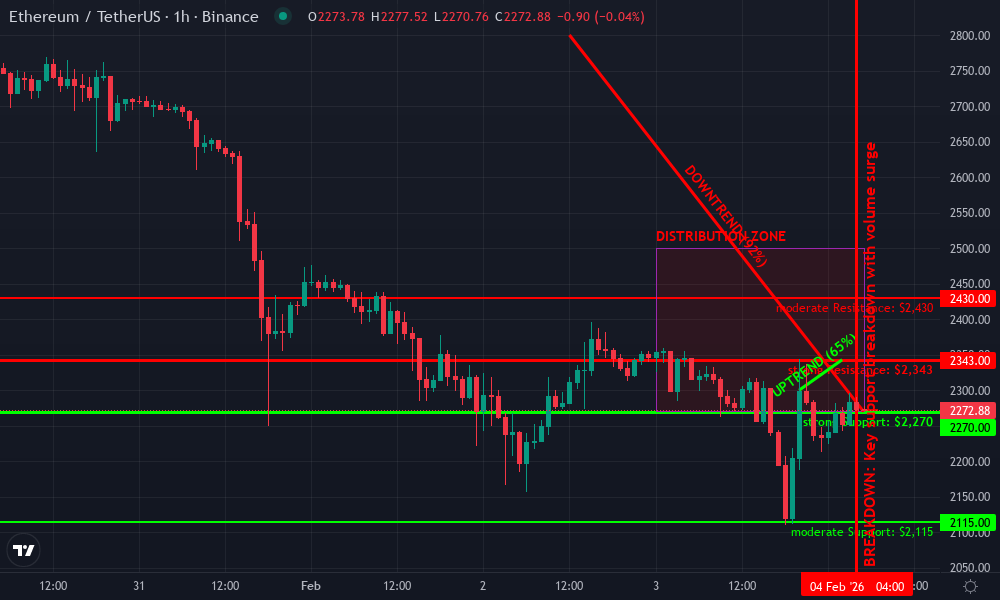
Analysis by Sarah Whitaker | Symbol: BINANCE:ETHUSDT | Interval: 1h | Drawings: 8
Technical Analysis Summary
Aggressively draw a thick red downtrend line connecting the swing high at 2026-02-02T14:00:00Z around $2,800 to the recent low at 2026-02-04T05:00:00Z at $2,270, extending it forward for potential further downside targets. Add horizontal resistance at $2,343 (24h high) and strong support at $2,270 (current price zone). Sketch fib retracement from the down move: 23.6% at $2,400, 38.2% at $2,450, 50% at $2,535. Mark short entry zone around $2,300 with a short_position tool, stop loss above $2,350, profit targets at $2,200 and $2,115 (24h low). Use arrow_mark_down on MACD bearish crossover and volume spike callouts for confirmation. Rectangle the recent consolidation between $2,270-$2,340 from 2026-02-04T00:00:00Z. In my bold style, highlight the breakdown with vertical_line at key pivot.
Risk Assessment: high
Analysis: Volatile crypto dump in downtrend with LRT news fading; high reward potential for aggressive shorts but whipsaw risk on bounces
Sarah Whitaker’s Recommendation: Go boldly short now—stake your claim in this restaking rout, my high-tolerance play! Target $2,100+ downside.
Key Support & Resistance Levels
📈 Support Levels:
-
$2,270 – Current price zone holding as intraday support near 24h low baseline
strong -
$2,115 – 24h low extension for deeper pullback target
moderate
📉 Resistance Levels:
-
$2,343 – 24h high rejection zone
strong -
$2,430 – Prior swing low turned resistance
moderate
Trading Zones (high risk tolerance)
🎯 Entry Zones:
-
$2,295 – Aggressive short entry on breakdown confirmation below $2,300 amid downtrend continuation
high risk -
$2,275 – High-risk long scalp on bounce from support for quick swing
high risk
🚪 Exit Zones:
-
$2,350 – Tight stop loss above resistance flip
🛡️ stop loss -
$2,200 – First profit target at projected fib extension
💰 profit target -
$2,115 – Ultimate downside target at 24h low
💰 profit target
Technical Indicators Analysis
📊 Volume Analysis:
Pattern: spike on downside with climactic volume
Increasing volume on red candles confirms bearish momentum, no reversal signs
📈 MACD Analysis:
Signal: bearish crossover below zero line
MACD histogram expanding negative, divergence supports further dump
Applied TradingView Drawing Utilities
This chart analysis utilizes the following professional drawing tools:
Disclaimer: This technical analysis by Sarah Whitaker is for educational purposes only and should not be considered as financial advice.
Trading involves risk, and you should always do your own research before making investment decisions.
Past performance does not guarantee future results. The analysis reflects the author’s personal methodology and risk tolerance (high).
Renzo’s ezETH chart exemplifies this precision; smoothed wicks contract during ETH volatility, hugging NAV tighter than pufETH’s wider bands. Opinion: dismiss candlestick purists; Heikin Ashi decodes eigenlayer LRT flywheels objectively, turning $8 billion TVL into actionable edges for yield optimizers.
Protocol Deep Dive: Selecting Your LRT Edge
Ether. fi edges ahead for purists seeking eETH’s seamless LST wrapping and EigenLayer-native points, ideal for compounding at ETH’s $2,270.80 floor. Renzo appeals to diversifiers, pooling stETH alongside cbETH for broader exposure, though ezETH’s 1.5% fee skim tests patience. Puffer’s pufETH prioritizes efficiency, automating AVS allocation to chase 18% APYs without manual nods. Swell’s rswETH, fresh entrant, layers restaking atop vanilla staking, suiting liquidity-first portfolios amid LRT TVL’s $8 billion milestone.
Cross-protocol arbitrage thrives too: swap eETH for ezETH on Curve when yields diverge, capturing basis trades as ETH stabilizes post $2,343.45 highs. This isn’t speculation; it’s calibrated staked ETH liquidity restaking, where LRTs morph DeFi from siloed yields to interconnected engines.
Forward gaze: as EigenLayer AVSs proliferate in 2026, LRTs will anchor Ethereum’s security marketplace, drawing trillions in shared stake. At current valuations, positioning in eETH or ezETH hedges ETH’s -3.10% pullback while priming for modular upside. Protocols evolve defenses, but the vigilant, chart-attuned investor commands the yield curve. Dive into LRTs where liquidity meets layered returns, and watch capital efficiency redefine staking.
LRTs transform yield strategies on EigenLayer.
About the Author