


In the current Ethereum landscape, with ETH trading at $2,272.69 after a 24-hour dip of $46.86, restakers are laser-focused on protocols like EigenLayer to compound yields without incremental capital. EigenLayer restaking mechanics transform native ETH staking or Liquid Staking Tokens (LSTs) into multi-service security, letting a single position underpin Actively Validated Services (AVSs) while accruing EigenPoints and diverse ERC-20 rewards. This guide dissects the eigenlayer restaking mechanics, from points accrual to AVS reward claims, equipping you to navigate delegation dynamics and operator fees amid evolving mainnet realities.

EigenLayer’s architecture hinges on pooled security, where restaked assets secure Ethereum’s base layer plus external AVSs like data availability layers or oracles. Restakers deposit ETH or LSTs into EigenPods, then delegate to operators who stake on their behalf across chosen AVSs. Rewards emerge from AVS-specific emissions, split between operators (who take a configurable fee) and delegators. Off-chain calculations feed into on-chain Merkle roots, introducing a claim delay that balances efficiency with verifiability. As of now, no AVSs enforce penalties on mainnet, but slashing risks loom for future integrations.
Dissecting the EigenLayer Points System
The eigenlayer points system acts as a pre-token incentive layer, quantifying restaking commitment via staked amount, duration, and AVS diversity. Points accrue hourly, weighted by pod balance and delegation activity, positioning early participants for potential EIGEN airdrops. Unlike pure yield farms, points reward sustained exposure; withdrawing halts accrual, and undelegating from AVSs prunes associated points. Savvy restakers optimize by rotating LSTs like those from Lido or Rocket Pool into high-uptime operators, chasing inflection points where AVS adoption spikes points multipliers.
Charts don’t lie in DeFi: Heikin Ashi on EigenLayer TVL reveals consolidation patterns signaling the next points surge.
Check this deep dive on maximizing EigenPoints for 2025 strategies, blending LST liquidity with targeted AVS delegations.

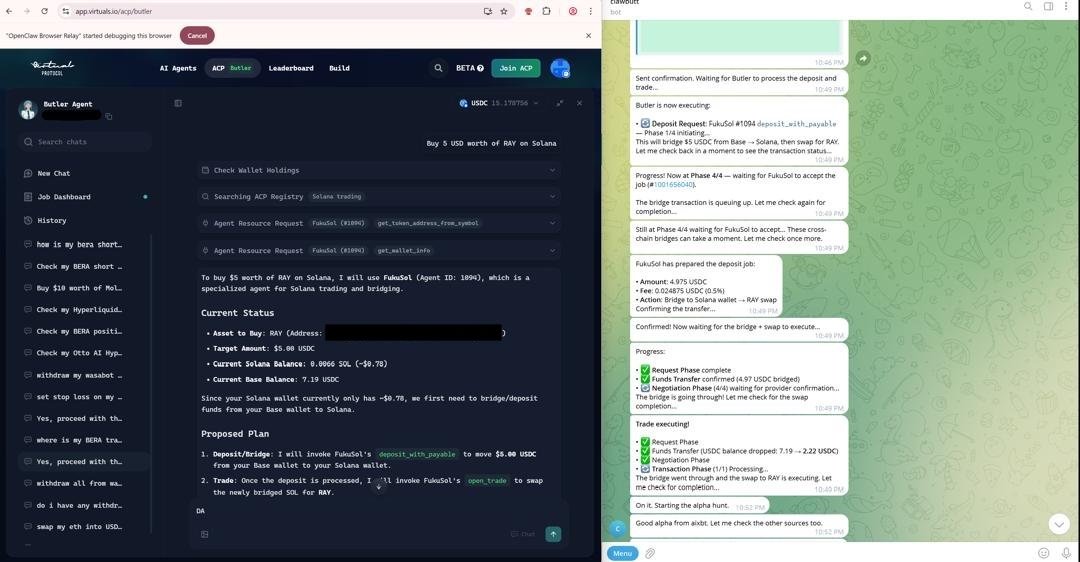
@virtuals_io has integrated its Agent Commerce Protocol (ACP) with OpenClaw agents.
ACP is Virtuals’ protocol for onchain commerce between AI agents. It’s built with smart contracts, ERC-8004, x402, and more.
By enabling verifiable, onchain payments, ACP https://t.co/hiujEUPmG0
Beyond its core features, OpenClaw agents can easily gain new capabilities through modular skills.
@heurist_ai provides a set of skills that let OpenClaw agents do things like:
> get market headlines
> find trending tokens
> look up prices and market contexts for https://t.co/wFbDBHSxdZ

@monad has been really active on Crypto x AI for a while and they’re moving fast again.
Monad is hosting the Moltiverse Hackathon to kickstart an ecosystem built around OpenClaw agents.
It’s a 2-week sprint with $200k in prizes, supported by @withAUSD, @dragonfly_xyz, https://t.co/e3pSJ8favw

AVS Rewards Restaking: Delegation and Yield Streams
AVS rewards restaking unlocks parallel income: AVSs distribute ERC-20 tokens based on service uptime and demand, funneled through operators to delegators post-fee. Select AVSs via the EigenLayer app, where claimable rewards for AVS emissions and programmatic incentives appear distinctly. Delegation isn’t one-size-fits-all; operators set fees from 0-100%, so precision in selection via on-chain reputation metrics is key. With ETH at $2,272.69, even modest 5-10% annualized AVS yields compound aggressively over lockups.
Current dynamics favor diversified baskets: EigenDA for data availability, oracles for cross-chain verification. Rewards vest with Merkle delays, claimable individually to minimize gas. Track via EigenLayer dashboards, where points and rewards snapshot in real-time.
Ethereum (ETH) Price Prediction 2027-2032 Amid EigenLayer Restaking and AVS Growth
Forecast incorporating restaking yield projections, AVS expansion, and market cycles (baseline: $2,273 in 2026)
| Year | Minimum Price | Average Price | Maximum Price | YoY % Change (Avg) |
|---|---|---|---|---|
| 2027 | $2,100 | $3,500 | $6,000 | +54% |
| 2028 | $2,800 | $4,800 | $8,500 | +37% |
| 2029 | $3,800 | $6,500 | $11,000 | +35% |
| 2030 | $5,200 | $8,900 | $15,000 | +37% |
| 2031 | $6,800 | $11,500 | $19,500 | +29% |
| 2032 | $9,000 | $14,800 | $25,000 | +29% |
Price Prediction Summary
ETH prices are forecasted to grow steadily through 2032, fueled by EigenLayer’s restaking mechanics enabling higher yields from AVS rewards. Bullish scenarios reflect AVS adoption and Ethereum upgrades, while minimums account for bearish market corrections and regulatory risks. Average price could reach $14,800 by 2032, a ~6.5x increase from 2026 levels.
Key Factors Affecting Ethereum Price
- EigenLayer AVS growth driving restaking rewards and EigenPoints accumulation
- Ethereum scalability upgrades (e.g., Dencun, Prague) boosting TVL in restaking
- Institutional inflows via ETH ETFs and LST integrations
- Regulatory clarity on staking/restaking reducing risks
- Macro cycles favoring crypto bull runs post-2026
- Competition from L2s and slashing risks in AVS operations
Disclaimer: Cryptocurrency price predictions are speculative and based on current market analysis.
Actual prices may vary significantly due to market volatility, regulatory changes, and other factors.
Always do your own research before making investment decisions.
Navigating Claims: From Merkle Roots to Wallet
Claiming kicks off in the EigenLayer interface: post-Merkle submission, rewards display under AVS and incentives tabs. Select tokens, approve, and execute; gas optimization via bundlers cuts costs during congestion. Everstake and Figment guides highlight wallet integrations, but always verify operator cuts upfront. Off-chain proofs ensure integrity, slashing disputes if invalid. For operators, V1 release enables direct ERC-20 submissions, streamlining to stakers.
Pro tip: Time claims around ETH lows like today’s $2,272.69 to arb gas, then restake proceeds into fresh AVS slots for uninterrupted points flow. This cycle embodies restaking’s edge: liquidity without liquidation risk, yields without silos.
About the Author