
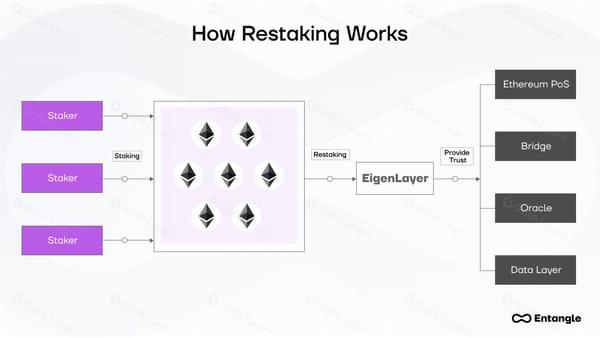
What liquid restaking tokens offer
Liquid restaking tokens (LRTs) are digital representations of restaking positions, allowing users to deposit Ethereum into DeFi protocols while maintaining liquidity. Unlike standard staking, where assets are locked to secure the network, LRTs enable the same capital to generate yield from multiple sources simultaneously. This structural shift has expanded the utility of staked ETH, creating a more flexible layer within the Ethereum ecosystem.
The market for these tokens has grown significantly, with a total market capitalization near $18.3 billion as of 2026, according to CoinGecko data. This valuation reflects the increasing demand for capital efficiency, as investors seek to maximize returns without sacrificing the ability to trade or manage their positions. The mechanism works by issuing a token that tracks the value of the underlying restaked ETH, which accrues rewards from both the base consensus layer and additional service layers.
However, this complexity introduces new risks. By restaking ETH across multiple protocols, users expose their capital to shared fault conditions. If one of the underlying services fails or is slashed, the entire restaked position can be compromised. This interconnectedness means that LRTs are not just a yield product but a leveraged bet on the security and reliability of the broader DeFi infrastructure.
Top LRT protocols ranked by metrics
Liquid restaking tokens (LRTs) have matured from experimental yield aggregators into core infrastructure for Ethereum's rollup ecosystem. Comparing Ether.fi, Renzo, and Kelp DAO requires looking past marketing narratives to the underlying mechanics of yield generation and risk exposure.
The primary differentiator among these protocols is not just the nominal APY, but the composition of that yield. Ether.fi relies heavily on its dual-token model (eETH/weETH) to capture restaking rewards from EigenLayer, while Renzo and Kelp offer more modular entry points that can aggregate yields from multiple LSTs. Understanding these structural differences is essential for positioning capital in a high-stakes environment.
The table below compares the three leading LRTs based on Total Value Locked (TVL), primary yield sources, and underlying protocol dependencies. These metrics reflect the current state of the market, though TVL figures fluctuate daily with ETH price movements and restaking demand.
| Protocol | Approx. TVL | Primary Yield Source | Underlying Asset |
|---|---|---|---|
| Ether.fi | $1.8B | EigenLayer AVS Rewards + LST Staking | eETH / weETH |
| Renzo | $1.2B | Restaking Points + ETH Staking | ezETH |
| Kelp DAO | $800M | EigenLayer Rewards + LST Aggregation | rsETH |
Each protocol presents a distinct risk profile. Ether.fi’s deep integration with EigenLayer makes it a bellwether for the entire restaking sector, meaning its performance is tightly coupled with the health of AVS (Actively Validated Services) operators. Renzo’s ezETH is designed for composability, often used as collateral in other DeFi protocols, which adds liquidity utility but also smart contract complexity. Kelp’s rsETH focuses on optimizing yield through efficient LST aggregation, offering a more passive exposure to restaking rewards.
Where Yield Comes From
Liquid Restaking Tokens (LRTs) generate yield through two distinct structural layers. The first layer is the base yield from securing the Ethereum network, which remains the foundation of all staking returns. The second layer emerges from restaking: protocols like EigenLayer allow users to "re-pledge" these staked assets to secure additional decentralized services, known as AVSs (Actively Validated Services). This transforms a passive security deposit into an active resource for other blockchain infrastructure, creating a secondary revenue stream.
This dual-yield mechanism is not without complexity. While base Ethereum staking rewards are relatively predictable, yield from AVSs varies significantly based on demand and the specific security services required. Some protocols distribute these rewards directly to token holders, while others retain a portion to fund protocol development or insurance reserves. Understanding this distribution model is critical for assessing the true risk-adjusted return of any LRT.
Risks in Liquid Restaking Derivatives
Liquid restaking tokens amplify yield by layering staking positions, but this structure introduces compounding risk vectors. Unlike simple staking, LRTs expose capital to multiple failure points across different protocol layers. Understanding these structural vulnerabilities is essential for managing exposure in a high-stakes environment.
Smart Contract Complexity
LRTs rely on intricate code interactions between liquid staking tokens (LSTs) and restaking protocols like EigenLayer. Each additional layer of abstraction increases the attack surface for smart contract exploits. A vulnerability in the underlying LST or the restaking vault can lead to total loss of principal, not just yield. The complexity makes independent audit verification critical, as bugs often emerge in edge cases during high-load conditions.
Slashing Events
Slashing remains the most direct threat to restaked capital. If the delegated validator operator misbehaves—such as by double-signing or going offline—the network penalizes the stake. In a restaking context, this penalty is applied to the underlying ETH or LST, which directly reduces the value of the LRT. Unlike standard staking, where slashing might be limited to a single validator set, restaking often aggregates multiple positions, potentially magnifying the impact of a single operator failure across the entire protocol.
Depegging Potential
LRTs trade at a premium or discount to their underlying net asset value (NAV). During periods of market stress or protocol uncertainty, this peg can break. If users rush to exit simultaneously, selling pressure can drive the LRT price below its intrinsic value, creating a liquidity trap. This depegging risk is exacerbated if the underlying assets (like stETH) also experience volatility, creating a cascading effect that erodes confidence and value.
LRT Yield Farming Strategies
Liquid restaking tokens (LRTs) serve as efficient collateral in lending markets, allowing you to leverage staked assets without selling them. By depositing LRTs as collateral, you can borrow stablecoins to deploy in other yield-generating opportunities, effectively stacking yields.
This strategy amplifies returns but introduces liquidation risk. If the LRT price drops relative to the borrowed asset, your position may be liquidated. Always maintain a conservative loan-to-value ratio and monitor oracle feeds closely.
Liquid Restaking Token FAQ
What is a liquid restaking token? An LRT is a derivative token issued when you deposit ETH into a liquid restaking protocol. Unlike standard liquid staking, LRTs allow you to restake your ETH again on secondary networks (Actively Validated Services) while retaining liquidity. This creates a "stacking" effect where your capital earns yield from multiple sources simultaneously. However, this complexity introduces additional smart contract risk layers. For a structural breakdown, see Validation Cloud’s explanation of LRT mechanics.
Can you still mine Ethereum in 2026? No. Ethereum transitioned to Proof-of-Stake (PoS) with the Merge in September 2022. Mining, which relied on Proof-of-Work (PoW) hardware, is obsolete. Any service claiming to offer "Ethereum mining" is likely fraudulent or referring to unrelated altcoins. The only way to participate in ETH consensus now is through staking or restaking.
Which coins will pump in 2026? We do not provide price predictions or speculative investment advice. Crypto markets are highly volatile, and no model can reliably forecast short-term price movements. Investors should focus on protocol fundamentals, revenue models, and risk parameters rather than speculative price targets.
Will Bitcoin hit $150,000 in 2026? This is a speculative question with no factual answer. Bitcoin’s price is driven by macroeconomic factors, adoption rates, and market sentiment. While some analysts project various price ceilings, these are estimates, not guarantees. Always conduct your own due diligence before making financial decisions.
No comments yet. Be the first to share your thoughts!