
What are restaking derivatives in 2026?
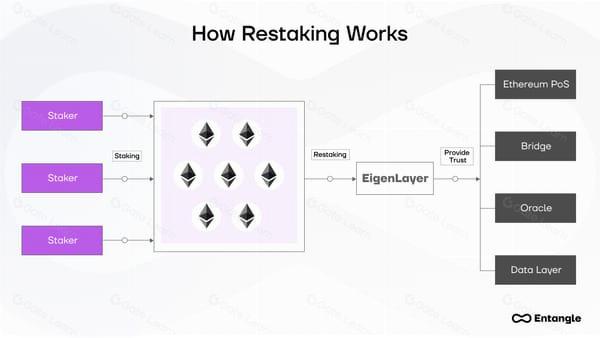
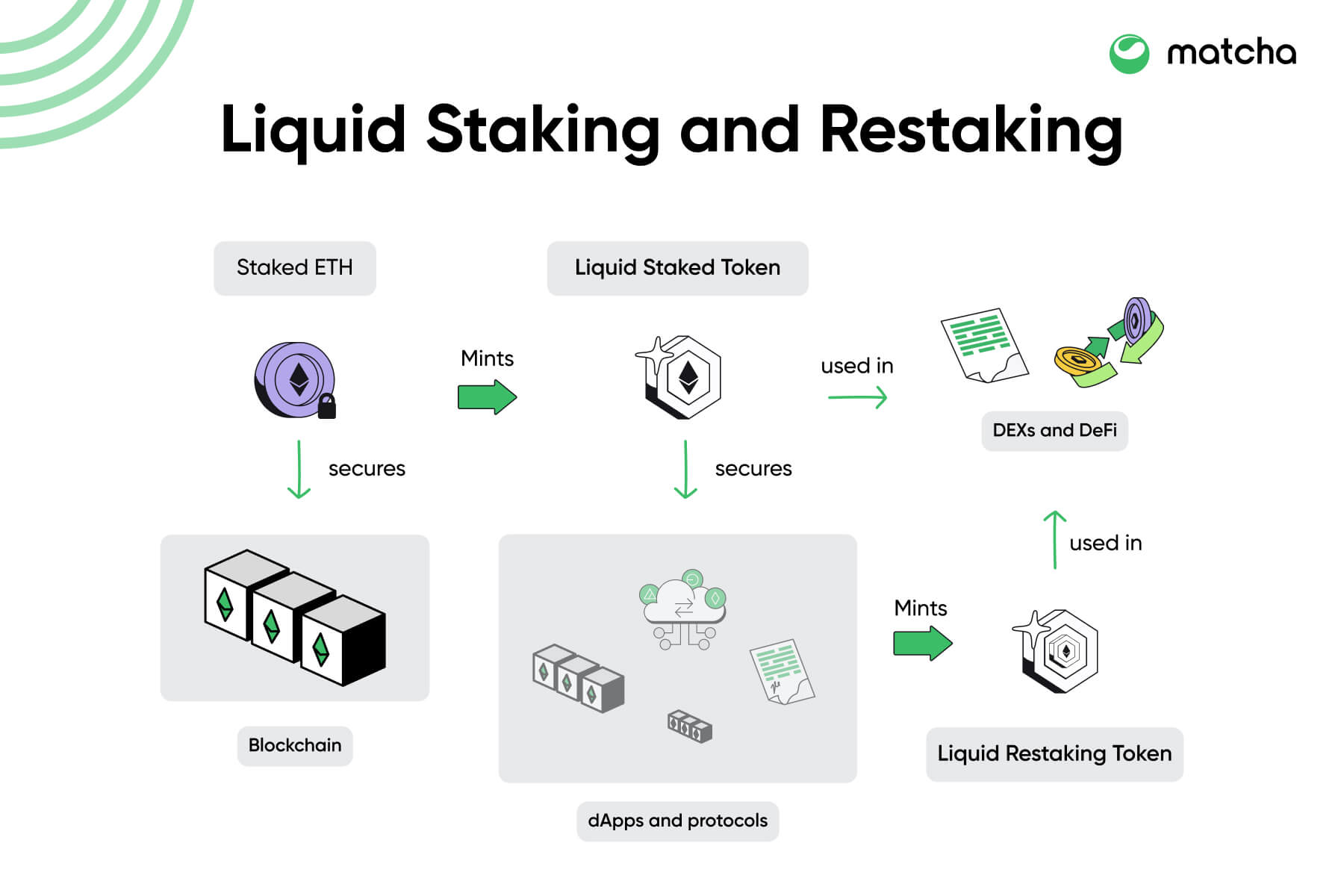
Restaking derivatives are tokenized claims on staked assets that have been reused to secure additional networks. In 2026, this mechanism allows you to earn yield from Ethereum staking while simultaneously providing security to Actively Validated Services (AVSs). The primary instrument for this is the Liquid Restaking Token (LRT), which represents your position in the restaking protocol.
Think of restaking derivatives as financial leverage on security. Instead of locking your ETH in a vault and waiting, you deposit it into a restaking layer. The protocol then "restakes" that capital to validate other tasks, like data availability or oracle services. In return, you receive a derivative token that accrues rewards from both the base Ethereum layer and the additional AVS layers.
The landscape has shifted significantly with the rollout of EigenLayer v2. This upgrade introduced more sophisticated slashing conditions and a broader set of AVSs, making the yield potential more transparent but also increasing the complexity of risk management. For many investors, LRTs offer a way to diversify yield sources without managing multiple wallets or validators.
However, the derivative nature of these tokens introduces new variables. Unlike simple staking, where rewards are predictable, restaking yields fluctuate based on AVS demand and network congestion. Understanding how these derivatives trade and how their underlying security models function is essential for anyone looking to allocate capital in this space.
Restaking derivatives 2026 choices that change the plan
When evaluating liquid restaking tokens (LRTs) like those built on EigenLayer v2, you are trading complexity for yield. The primary benefit is the "security premium"—additional yield earned by securing Actively Validated Services (AVSs) beyond basic Ethereum consensus. However, this comes with layered smart contract risk and varying liquidity profiles.
To make an informed decision, compare the core tradeoffs across leading protocols. The following table breaks down the key differences between major LRTs and standard staking in 2026.
| Feature | ether.fi | Renzo | Kelp DAO | Standard Staking |
|---|---|---|---|---|
| Base Yield | ~3.0–3.5% | ~2.8–3.2% | ~2.9–3.3% | ~3.0% |
| Security Premium | High (Multi-AVS) | Medium (Selective) | Medium (Modular) | None |
| Liquid Token Utility | Deep DeFi Integration | Broad Lending Protocols | Curated Partnerships | None (Locked) |
| Smart Contract Risk | Higher (Complex Ops) | Moderate (Optimized) | Moderate (Audited) | Lower (Simplified) |
| Slashing Exposure | Yes (AVS-specific) | Yes (AVS-specific) | Yes (AVS-specific) | Yes (Consensus only) |
Liquidity and Yield Variability
Liquidity is the most immediate tradeoff. Standard staking locks your ETH, offering no exit option until withdrawal queues clear. LRTs solve this by issuing a derivative token (e.g., eETH, ezETH) that can be traded or used in lending markets. However, this liquidity comes at a cost: yield variability. While standard staking offers a predictable ~3.0% base yield, LRT yields fluctuate based on AVS demand and protocol fees. In 2026, the "security premium" can add 0.5–1.5% annually, but it is not guaranteed.
Smart Contract and Slashing Risk
Restacking introduces additional smart contract layers. Each AVS you secure through an LRT adds a new code path that could potentially be exploited. While major protocols like Ether.fi and Renzo have undergone rigorous audits, the complexity of modular restaking means the attack surface is larger than standard solo staking. Also, slashing risk extends beyond consensus errors. If an AVS you are securing is slashed for misbehavior, your LRT value may drop. Standard staking only exposes you to consensus-level slashing, which is rare and well-understood.
Decision Framework
Choose standard staking if you prioritize capital preservation and simplicity. It is the safest route for long-term holders who do not need active liquidity. Opt for LRTs like Ether.fi or Renzo if you are comfortable with higher smart contract risk in exchange for yield enhancement and DeFi composability. Kelp DAO offers a middle ground with a more curated approach to AVS integration, reducing some complexity while still providing a security premium. Always review the specific AVS policies of each protocol before committing capital.
Choose the next step
Restaking Derivatives works best as a clear sequence: define the constraint, compare the realistic options, test the tradeoff, and choose the path with the fewest hidden costs. That order keeps the advice usable instead of decorative. After each step, pause long enough to check whether the recommendation still fits the reader's actual situation. If it depends on perfect timing, unusual access, or a best-case budget, include a simpler fallback.

Spotting Weak Options and Misleading Claims
The restaking narrative is expanding, but not every protocol offers the same security or yield quality. When evaluating LRTs, look past the promotional yield numbers and examine the underlying risk layers. Many projects bundle multiple risks together, making it difficult to isolate where your capital is actually exposed.
The Danger of Double-Counted Security
A common misleading claim is that restaking provides "double security." In reality, you are often reusing the same underlying ETH stake to secure different services. If the primary Ethereum consensus layer is compromised, your restaked assets are vulnerable across all dependent protocols. This creates a correlated risk that standard staking does not have. Always check if the Actively Validated Services (AVSs) have independent slashing conditions or if they rely entirely on the base layer.
Yield Farming vs. Sustainable Returns
Another weak option is relying on high, unsustainable APYs driven by incentive tokens. Many LRTs offer inflated yields by distributing their own governance tokens. These rewards often drop significantly once the incentive period ends. Compare the base staking yield with the token emissions. If the majority of your return comes from volatile governance tokens, the option is speculative rather than a stable yield play.
Smart Contract Complexity
Restaking introduces more smart contract interactions than simple staking. Each additional layer—such as the LRT wrapper, the restaking vault, and the AVS interface—adds potential attack surface. Look for protocols with extended audit histories and bug bounty programs. Avoid newer, unaudited protocols that promise higher returns as a trade-off for security simplicity. The complexity is the price you pay for the yield, and it should be transparently documented.
Restaking derivatives 2026: what to check next
These answers address the most common objections and misconceptions surrounding liquid restaking tokens (LRTs) and EigenLayer v2 as we move through 2026.
What is the difference between Ethereum staking and restaking?
Standard staking locks ETH to secure the Ethereum mainnet, earning a base yield of roughly 2.8–3.2%. Restaking takes that staked ETH and re-delegates it to secure additional decentralized protocols, known as Actively Validated Services (AVSs). This adds a "security premium" on top of the base yield, effectively turning one asset into a multi-layer yield engine. While staking is a single-layer commitment, restaking introduces composability but also layered risk.
Can you still mine Ethereum in 2026?
No. Ethereum transitioned to proof-of-stake in September 2022, ending proof-of-work mining permanently. There is no GPU mining available for ETH. Investors seeking exposure to Ethereum’s yield must now use staking or restaking protocols. Mining remains possible for other coins like Bitcoin or Litecoin, but not for the Ethereum network.
Which crypto will boom in 2026?
While no one can predict specific price targets with certainty, the restaking sector has emerged as a structural shift in digital asset yield. By late February 2026, the broader restaking sector held over $13.45 billion in total value locked (TVL). Protocols like EigenLayer and leading LRTs such as Ether.fi, Renzo, and Kelp Protocol are seeing increased adoption as they offer higher yields than traditional staking. The boom is driven by utility and yield generation rather than speculative hype alone.
Will Bitcoin hit $150,000 in 2026?
Price predictions for Bitcoin vary widely among analysts. Some bullish forecasts suggest $150,000 is possible if institutional adoption accelerates and macroeconomic conditions remain favorable. However, this is not a guaranteed outcome. Bitcoin’s price remains highly volatile and dependent on broader market sentiment, regulatory developments, and ETF inflows. Investors should treat such targets as scenarios, not promises.
No comments yet. Be the first to share your thoughts!