
The restaking yield stack explained
Restaking derivatives represent a structural shift in how Ethereum validators earn returns. Instead of locking staked ETH to secure only the base layer, validators delegate their security to additional networks through restaking protocols. This mechanism allows a single unit of staked capital to generate multiple revenue streams simultaneously. As of March 2026, Ethereum solo staking offers approximately 2.8–3.2% base yield, while restaking protocols layer a specialized "security premium" on top of those foundational returns [src-serp-3].
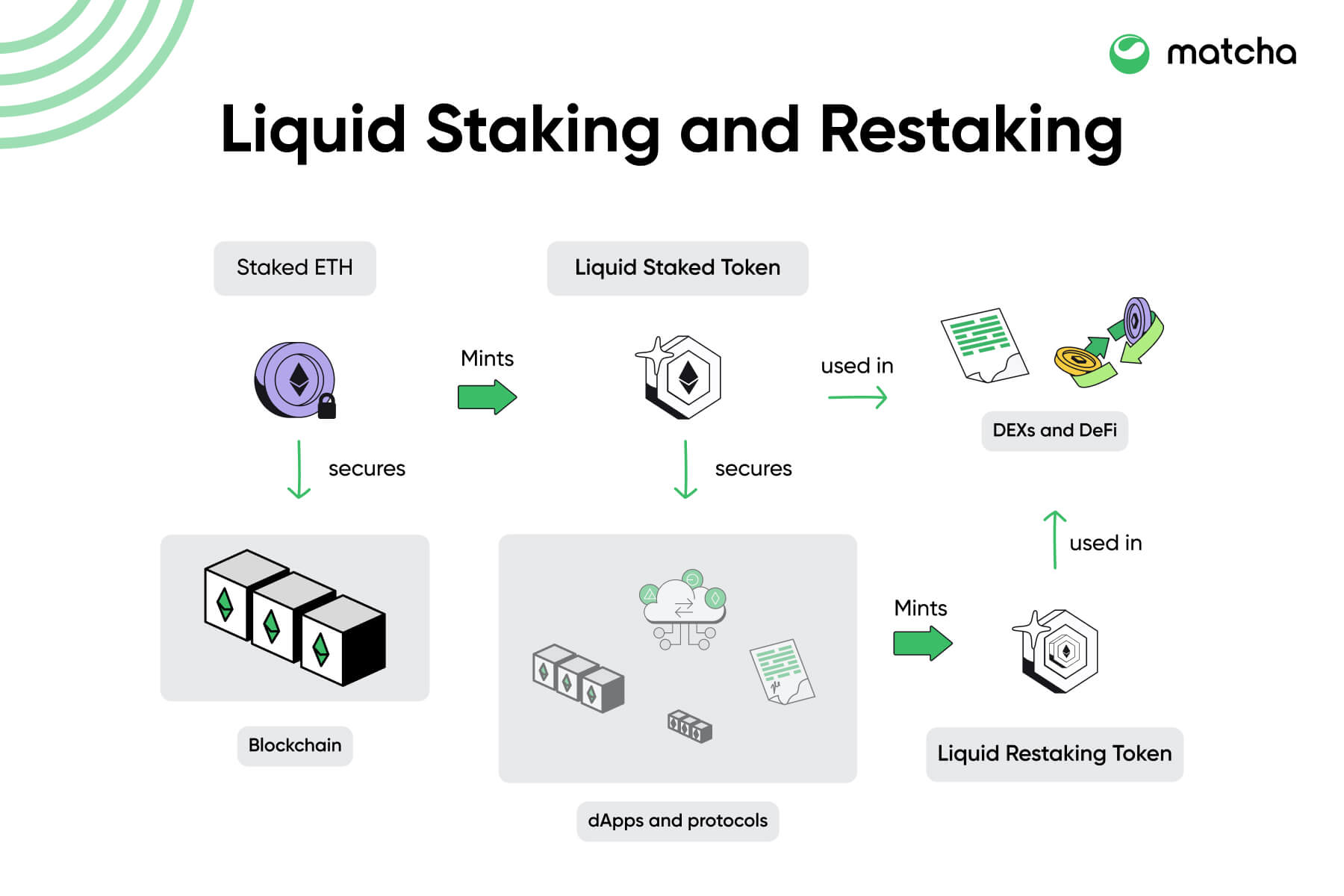
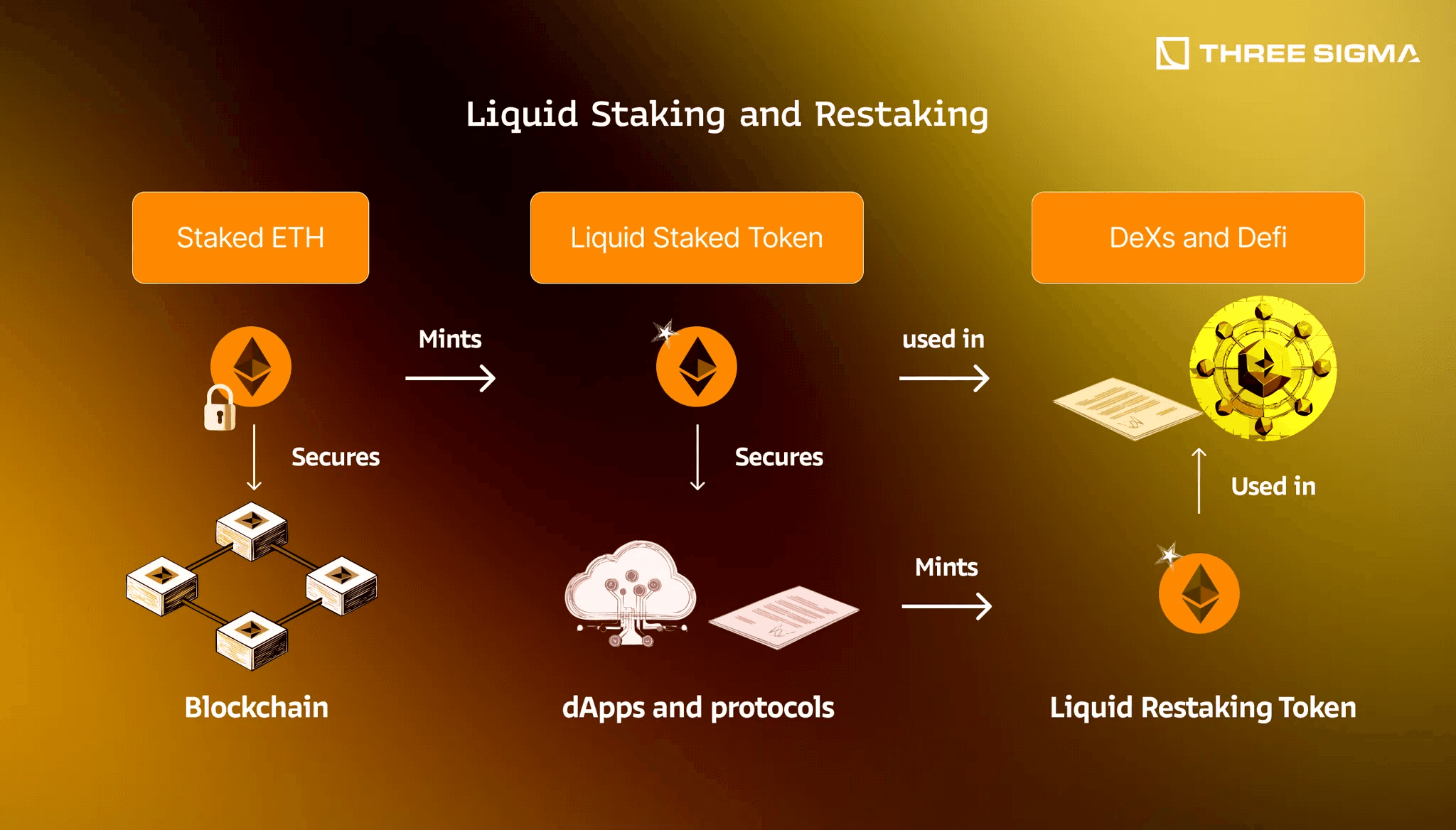
The mechanics rely on liquid restaking tokens (LRTs). When a validator restakes, they receive an LRT that represents their staked ETH plus accrued security services. These tokens can then be used across various decentralized finance (DeFi) applications, such as lending markets or automated market makers, to generate additional yield. This creates a stacked yield model where income is derived from base staking rewards, restaking security fees, and DeFi trading fees or lending interest.
This layering process effectively turns static staking positions into active financial instruments. However, it also introduces complex risk vectors. If the underlying Ethereum network experiences a slashing event, the validator loses their primary stake. If the restaking protocol or the downstream DeFi applications fail, the secondary yield streams vanish. Understanding this hierarchy is essential for evaluating the true risk-adjusted return of any restaking derivative.
Top liquid restaking tokens compared
The liquid restaking token (LRT) market has consolidated around three primary protocols that dominate total value locked (TVL) and yield generation. Understanding the structural differences between Ether.fi, Renzo, and Kelp is essential for identifying which protocol aligns with your risk and yield objectives.
These protocols do not merely re-stake assets; they layer distinct risk management frameworks and yield compositions. Ether.fi focuses on diversified EigenLayer AVS (Actively Validated Services) exposure. Renzo emphasizes automated yield optimization and liquidity provision. Kelp offers a more conservative approach with a focus on native staking yields and lower complexity.
The following comparison highlights the key metrics that distinguish these leaders. Use this data to evaluate which protocol offers the appropriate balance of yield and security for your portfolio.
| Protocol | TVL (Est.) | Primary Yield Source | Key Feature |
|---|---|---|---|
| Ether.fi | $1.8B+ | EigenLayer AVS + ETH Staking | Diversified AVS exposure |
| Renzo | $650M+ | Optimized Restaking + Liquidity | Auto-compounding & EZETH |
| Kelp | $400M+ | Native Staking + RSETH | Conservative yield profile |
Each protocol carries a unique risk profile. Ether.fi’s broad AVS diversification reduces single-point failure risk but introduces complexity in tracking underlying rewards. Renzo’s automated strategies aim to maximize returns but may involve higher smart contract risk due to complex yield aggregation. Kelp’s simpler structure appeals to users prioritizing transparency and lower operational risk over maximum yield.
When selecting an LRT, verify the current TVL and yield rates directly from the protocol’s official dashboard. Market conditions shift rapidly, and static comparisons may not reflect real-time performance. Always review the protocol’s smart contract audits and risk disclosures before allocating capital.
How EigenLayer Drives the Market
EigenLayer has become the structural engine for Ethereum’s restaking ecosystem, introducing the concept of shared security. Instead of staked ETH merely securing the base layer, it can now be delegated to Active Verification Services (AVSs)—new protocols that require blockchain security but lack their own validator set. This mechanism allows ETH stakers to earn a security premium by backing additional networks, effectively turning "trapped" capital into multi-layer yield engines.
The value proposition is straightforward: capital efficiency. By restaking, validators can generate yield from multiple sources simultaneously. However, this introduces complex risk vectors. Slashing conditions from AVSs apply to the restaked ETH, meaning a failure in a third-party protocol can penalize the staker’s primary Ethereum stake. This interdependence means that the health of the broader DeFi ecosystem is now directly tied to the security practices of individual AVSs.
As adoption grows, the total value locked in EigenLayer continues to rise, signaling strong demand for shared security. Investors must carefully assess the risk profiles of specific AVSs before delegating. The shift represents a fundamental change in how network security is priced and distributed, moving from isolated chains to a interconnected web of delegated trust.
Where the slashing risk lives
Restaking introduces a layer of shared liability that does not exist in standard staking. When you restake ETH, you are not just securing the Ethereum consensus layer; you are also providing cryptographic security to additional protocols, often referred to as Actively Validated Services (AVSs). This creates a complex web of dependencies where the failure of one component can trigger penalties across the entire chain.
The mechanics of slashing
Slashing is the penalty mechanism enforced by the Ethereum protocol and EigenLayer. If a validator node behaves maliciously or goes offline, the protocol confiscates a portion of the staked ETH. In a restaking context, the risk is amplified because your same staked assets are now vouching for the integrity of multiple independent protocols. A misbehavior event in any one of these AVSs can lead to slashing, reducing your principal and future yield potential.
Smart contract vulnerabilities
Beyond consensus-layer penalties, restaking derivatives rely on complex smart contracts to manage liquidity and rewards. These contracts introduce operational risks, including bugs, exploits, and governance failures. Unlike native staking, where the risk is primarily technical (node performance), restaking exposes capital to the specific codebase of the AVS and the restaking middleware. A vulnerability in any single contract in the stack can result in total loss of the associated restaked assets.
The EigenLayer shift has accelerated the adoption of restaking, but it has also concentrated risk. As more capital flows into shared security, the potential impact of a single slashing event or contract failure grows. Investors must understand that the yield premiums offered by restaking are direct compensation for assuming these heightened, interconnected risks.
Checklist for safe restaking entry
Before depositing assets into restaking protocols, verify the underlying mechanics and risk parameters. The sector holds over $13 billion in TVL, but yield sustainability varies wildly between protocols. Use this workflow to evaluate EigenLayer-based projects and liquid restaking tokens (LRTs) before committing capital.
Confirm that both the LRT smart contracts and the underlying EigenLayer contracts have undergone recent, reputable security audits. Check for disclosed vulnerabilities and whether the team has addressed them. Unaudited code or unresolved critical findings are immediate disqualifiers for high-stakes capital.
Understand exactly what triggers slashing. Restaking amplifies yield but also exposes your assets to the security failures of Actively Validated Services (AVSs). Review the protocol’s documentation to see if they have implemented "slashing insurance" or if you bear the full risk of validator misbehavior.
Compare the offered yield against the base Ethereum staking rate of approximately 2.8–3.2%. If the restaking premium seems unusually high, investigate the source. Sustainable yield comes from real AVS demand, not inflationary token emissions that will eventually dilute your position.

Ensure you understand the unbonding periods and exit liquidity options. Some protocols allow instant exit via secondary markets but charge a steep fee, while others lock your assets for weeks. Liquidity risk is a major factor in restaking; ensure you can access your funds if the market turns.
Use the chart above to monitor ETH price action alongside your staking decisions. Market volatility can impact the real-world value of your staked assets, even if the token count remains stable. Always correlate yield percentages with current market conditions.
Frequently asked questions about restaking
Can you still mine Ethereum in 2026?
No. Ethereum permanently ended proof-of-work mining in September 2022 with "The Merge." The network now operates entirely on proof-of-stake, meaning there are no longer any mining rigs or ASICs that can generate ETH through computational hashing. Investors looking for passive income must now use staking protocols instead.
Has Ethereum switched to proof-of-stake?
Yes. The transition to proof-of-stake was completed on September 15, 2022, when Ethereum executed "The Merge." This upgrade deprecated the energy-intensive proof-of-work consensus mechanism, reducing the network's energy consumption by approximately 99.95%. All current staking and restaking activities rely on this proof-of-stake infrastructure.
Will Ethereum hit $50,000?
Price predictions vary based on macroeconomic conditions and adoption rates. While some analysts project significant upside as institutional demand for restaking yields grows, Ethereum's price remains volatile. Current market dynamics show a shift toward yield-bearing assets, but no guarantee exists for specific price targets. Investors should monitor live market data rather than relying on static forecasts.
Will Ethereum rebound in 2026?
Ethereum's trajectory in 2026 is tied to the maturation of restaking ecosystems like EigenLayer. As the "security premium" for restaked assets integrates into broader DeFi, the network's utility expands beyond simple value storage. While past performance does not predict future results, the structural shift toward liquid staking and restaking provides a new layer of economic activity for the ecosystem.
No comments yet. Be the first to share your thoughts!