
How restaking derivatives work
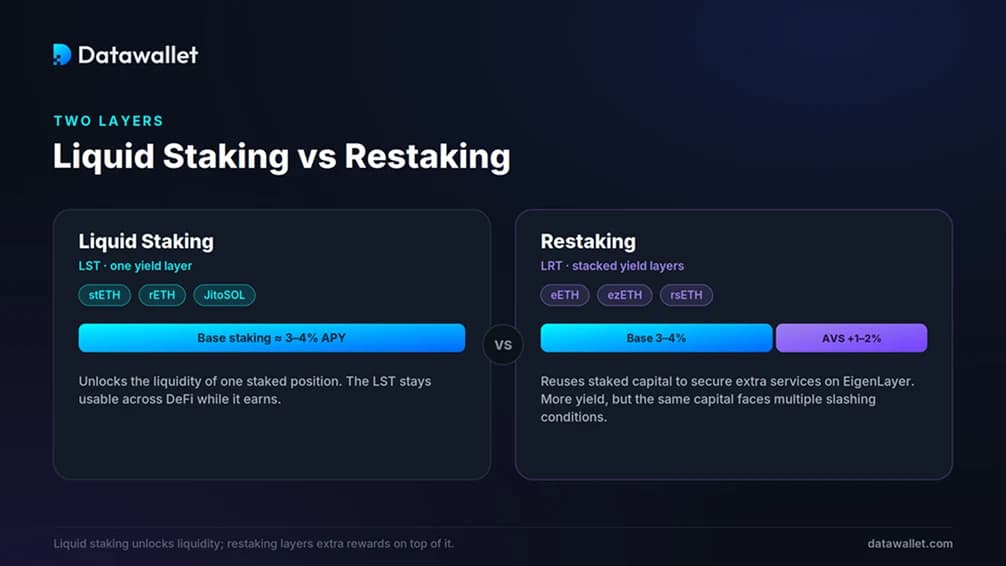
Restaking derivatives, often called Liquid Restaking Tokens (LRTs), layer economic security on top of existing staked assets. The mechanism starts with a standard Liquid Staking Token (LST), such as stETH. Instead of holding that token idle, you deposit it into a restaking protocol. The protocol then re-delegates the underlying validator rights to additional networks or services, generating extra yield while maintaining the original staking rewards.
This creates a distinct hierarchy. Standard liquid staking provides liquidity and basic Ethereum security. Restaking derivatives add a secondary layer of security, often referred to as "re-staking," where the same capital supports multiple consensus layers simultaneously. The difference between solo staking, liquid staking, and restaking is crucial in 2026 because these models are not interchangeable.
The core value proposition is capital efficiency. By allowing staked ETH to serve multiple purposes, restaking derivatives improve yield potential without requiring additional upfront capital. However, this layering introduces complex risk vectors, including slashing conditions that can affect the entire stack. Understanding this flow is essential before deploying capital.
Compare EigenLayer and EtherFi strategies
Restaking derivatives in 2026 are not interchangeable. While both EigenLayer and EtherFi allow you to earn yield from "trapped" capital, they serve different risk appetites and liquidity needs. Understanding the structural differences between these two dominant players is essential before deploying capital.
EigenLayer operates as a permissionless protocol that extends Ethereum's security to other protocols through Actively Validated Services (AVS). It is an infrastructure layer. EtherFi, conversely, is a liquid restaking token (LRT) protocol that simplifies the user experience by abstracting the complexity of managing multiple AVS exposures. It focuses on capital efficiency and composability within its own ecosystem.
The table below breaks down the core mechanics for comparison.
| Feature | EigenLayer | EtherFi |
|---|---|---|
| Primary Model | Permissionless Security Marketplace | Liquid Restaking Token (LRT) |
| Yield Source | AVS Fees + Staking Rewards | LRT Staking + AVS Rewards + Points |
| Risk Profile | Slashing risk per AVS selected | Slashing risk spread across LRT pool |
| Liquidity | Non-custodial ETH (eETH) or native | frxETH/frxETHv2 (highly liquid) |
| Complexity | High (manual AVS selection) | Low (single token interface) |
EigenLayer requires you to actively choose which AVSs to delegate to. This offers higher potential yields but concentrates slashing risk on specific protocol failures. If an AVS you support fails, your staked ETH is penalized. EtherFi spreads this risk across a larger pool of participants, making it safer for passive investors, though the yield per unit of capital is typically lower due to protocol fees and risk distribution.
For 2026, the choice depends on your technical comfort. If you want to maximize yield by picking specific high-performing AVSs, EigenLayer is the direct path. If you prefer a "set and forget" approach with easy DeFi composability, EtherFi’s LRT model is the standard. Always verify the latest AVS lists and slashing conditions on the official EigenLayer documentation and EtherFi whitepaper before committing funds.
Execute your restaking workflow
Restaking derivatives allow you to reuse staked assets to secure additional services (AVS) while earning layered yields. This workflow outlines the technical steps to acquire and stake Liquid Restaking Tokens (LRTs) in 2026. The process requires connecting a non-custodial wallet to a specialized protocol interface.

Begin by ensuring your wallet holds the native asset (e.g., ETH or SOL) and a small amount for transaction fees. Connect your non-custodial wallet (such as MetaMask or Phantom) to the LRT protocol’s official interface. Verify the URL to avoid phishing sites, as restaking platforms are frequent targets for exploits.
Navigate to the swap or deposit section. Instead of staking the native asset directly, swap it for an LRT (e.g., ezETH, rsETH, or jitoSOL). These tokens represent your staked position plus any accumulated yield, allowing you to remain liquid while your underlying asset secures the network. Check the exchange rate and slippage tolerance before confirming the transaction.
Once you hold the LRT, delegate it to a validator node. Choose a validator with a strong track record, low commission fees, and high uptime. Most LRT protocols automate this delegation, but you may need to explicitly select a validator if using a self-custodial LRT. This step ensures your stake is actively participating in consensus and earning base rewards.
Use your LRT to participate in Additional Validator Services (AVS). This is the core of restaking: your staked ETH now secures sidechains, oracles, or bridge infrastructure. Deposit your LRT into the AVS contract through the protocol dashboard. You will now earn yield from both the base consensus layer and the AVS service fees, compounding your returns.
Restaking introduces slashing risks; if the underlying validator misbehaves, your entire restaked position could be penalized. Monitor your dashboard for slashing events, validator performance, and protocol health. Consider using insurance protocols if available, and rebalance your positions if the yield-to-risk ratio becomes unfavorable. Keep an eye on governance proposals that may change protocol parameters.
Manage smart contract and slashing risks
Restaking derivatives amplify yield by reusing staked ETH across multiple protocols, but they also layer risk. A single smart contract vulnerability or slashing event can drain the underlying collateral. In 2026, the complexity of these multi-protocol interactions makes active risk management non-negotiable.
Audit verification
Never deposit into a protocol that lacks a recent, independent audit. Look for reports from reputable firms like OpenZeppelin or Trail of Bits. Check if the audit covered the specific restaking logic and not just the base token. If an audit is missing or outdated, treat the contract as unverified code.
Slashing protection
Slashing occurs when a validator misbehaves, resulting in a penalty to the staked ETH. While most liquid restaking tokens (LRTs) offer some form of slashing insurance, coverage limits vary. Understand the exact coverage cap and whether it applies per validator or per protocol. Without adequate protection, a single bad actor in the network can significantly reduce your principal.
Regulatory exposure
The regulatory landscape for LRTs is tightening. As noted by legal analysts, liquid restaking protocols face increasing scrutiny regarding their classification as securities. This regulatory uncertainty can lead to sudden protocol shutdowns or forced delistings from major exchanges. Diversify your exposure across multiple protocols to mitigate this systemic risk.
Warning: Regulatory scrutiny is intensifying for liquid restaking protocols. Ensure you understand the legal risks before committing capital.
Monitoring tools
Use on-chain monitoring dashboards to track validator performance and protocol health. Set up alerts for unusual contract interactions or large withdrawals. Early detection of anomalies can allow you to exit positions before a crisis escalates.
Check your portfolio performance
Restaking derivatives like liquid restaking tokens (LRTs) accrue yield in complex ways, making standard portfolio trackers insufficient. You need a dashboard that separates base staking rewards from restaking protocol incentives to avoid overestimating your returns.
Start by linking your wallet to a specialized DeFi analytics platform. Look for tools that explicitly support the specific LRT you hold, such as pETH or sfrxETH. These platforms break down your APY into its constituent parts: the underlying Ethereum validator yield and the additional restaking layer rewards. Without this granularity, you cannot accurately assess whether the extra yield justifies the added smart contract risk.
Monitor your position’s health against the underlying asset. If the restaking protocol experiences a slashing event or a liquidity crisis, the derivative may trade at a discount to ETH. Set up price alerts for your specific LRT. A significant divergence from the ETH price often signals protocol issues or market stress, prompting you to rebalance or exit before further losses.
Restaking derivatives 2026 FAQ
Restaking derivatives are reshaping how capital moves through Ethereum, but they introduce unique technical and regulatory risks. Here are the most common questions about how these instruments function in the current market.
What are restaking derivatives?
Restaking derivatives, often called Liquid Restaking Tokens (LRTs), allow users to stake their Ether to secure Ethereum’s proof-of-stake network while simultaneously re-staking that same capital to secure other protocols. This mechanism improves capital efficiency by earning rewards from multiple layers simultaneously. For a detailed breakdown of how these derivatives function, see the analysis by Bridge Harris on liquid staking developments [[src-serp-6]].
Is restaking legal in 2026?
The regulatory status of restaking remains under intense scrutiny. While Ethereum staking itself is generally accepted, the "restaking" layer—where assets are used to secure additional networks—has drawn attention from regulators concerned about unregistered securities. Legal experts at Katten Muchin Rosenman note that this dual-use nature faces heightened regulatory oversight [[src-serp-3]]. Always consult a qualified legal professional before trading these assets.
What are the main risks of restaking?
The primary risk is "smart contract risk" combined with "slashing risk." If the underlying protocol or the restaking middleware fails, users can lose their entire stake. Also, if the validator node misbehaves, the user can be "slashed" (penalized) by the Ethereum network. Unlike standard staking, restaking amplifies these risks because a single failure can cascade across multiple secured networks.
How does restaking differ from standard staking?
Standard staking involves locking Ether to help validate Ethereum blocks. Restaking takes that staked Ether and delegates it again to other services, like oracles or bridges. This creates a "stacked" security model where your assets protect more than just the Ethereum base layer, but it also means your assets are exposed to the failure of those additional protocols.
No comments yet. Be the first to share your thoughts!