
Define restaking derivatives in 2026
To plan around the restaking derivatives market, you must first understand that solo staking, liquid staking, and restaking are distinct mechanisms with different risk profiles. These models are not interchangeable. Confusing them leads to mispriced risk and unexpected exposure.
Solo staking involves running your own validator node. You hold the private keys, manage the infrastructure, and receive the full network reward. It offers maximum control but requires significant technical overhead and capital.
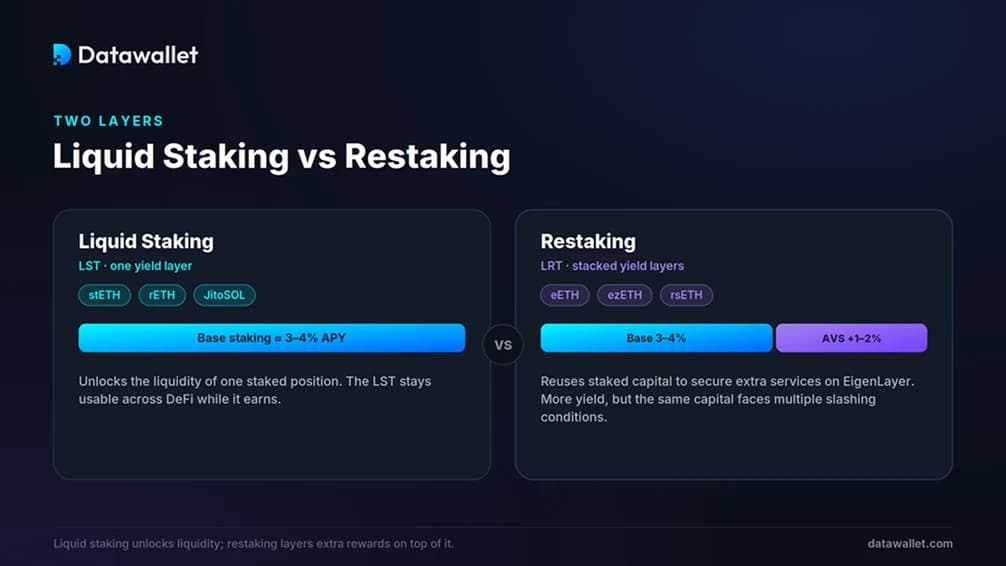
Liquid staking allows you to stake ETH without running a node. You deposit ETH into a protocol and receive a liquid staking token (LST), such as stETH or rETH, which represents your claim on the underlying asset and its rewards. This LST can be used in other DeFi protocols while remaining staked.
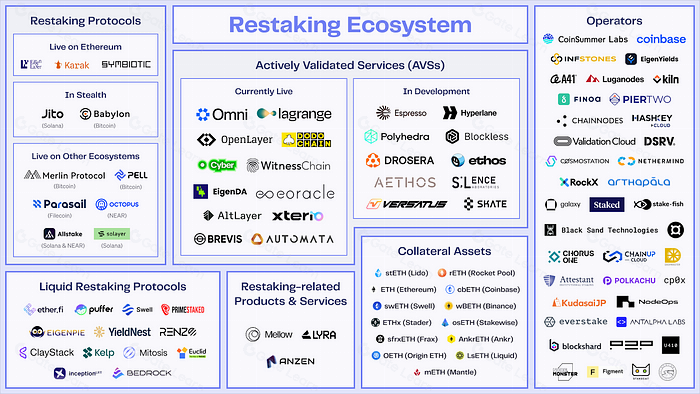
Restaking derivatives take this a step further. You take your LST and restake it on a protocol like EigenLayer. This re-delegates the security of your ETH to additional networks, known as Actively Validated Services (AVSs). In return, you earn extra yield from these AVSs. However, this introduces new risks, including slashing events across multiple protocols and smart contract complexity.
The core distinction lies in where your security is deployed. Solo staking secures Ethereum. Liquid staking secures Ethereum while providing liquidity. Restaking derivatives secure Ethereum and auxiliary services, amplifying both rewards and potential liabilities.
Select a liquid restaking token provider
Navigate Restaking Derivatives works best as a clear sequence: define the constraint, compare the realistic options, test the tradeoff, and choose the path with the fewest hidden costs. That order keeps the advice usable instead of decorative. After each step, pause long enough to check whether the recommendation still fits the reader's actual situation. If it depends on perfect timing, unusual access, or a best-case budget, include a simpler fallback.
Execute the staking transaction
Depositing ETH into a restaking protocol to receive liquid restaking tokens (LRTs) requires precision. Unlike simple staking, restaking involves interacting with smart contracts that delegate your security to multiple Active Validator Services (AVSs). A single error in the transaction data can result in permanent loss of funds.
Follow this sequence to ensure your deposit is secure and optimized for gas costs.
Before depositing ETH, you must authorize the restaking protocol to access your funds. This is an on-chain approval transaction. Use a block explorer like Etherscan to verify the contract address you are interacting with. Ensure the contract is the official version of the protocol you intend to use, not a phishing clone. Set the approval limit to the exact amount of ETH you plan to restake to minimize exposure.
Restaking transactions can be complex, involving multiple contract calls. High network congestion can lead to failed transactions or excessive fees. Check current gas prices on a tracker like EthGasWatch. If the network is congested, consider using a Layer 2 solution if the protocol supports it, or wait for a low-traffic window. This step is critical for cost efficiency and transaction success.
Navigate to the protocol’s official dashboard or interface. Select the "Deposit" or "Restake" function. Enter the amount of ETH you wish to deposit. Double-check the recipient contract address and the destination AVSs. Confirm the transaction in your wallet. The interface should display the expected gas fee and the estimated time for confirmation. Once confirmed, you will receive LRTs in your wallet, representing your restaked position.
-
Verify the official contract address on Etherscan
-
Check current gas prices on EthGasWatch
-
Confirm the destination AVSs in the deposit interface
-
Ensure your wallet has enough ETH for gas fees
Manage restaking risks and slashing
Restaking amplifies yield but multiplies exposure. When you delegate your staked ETH to an Actively Validated Service (AVS), you are not just securing one network; you are sharing the same collateral across multiple protocols. This creates a "dual-slashing" risk: a single malicious act—such as signing conflicting blocks—can trigger penalties from both the Ethereum base layer and the AVS you support. If you are staking across several AVSs, one failure can cascade, draining your position faster than single-chain staking.
Smart contract vulnerabilities add another layer of danger. Restaking relies on Liquid Restaking Tokens (LRTs) and complex bridging logic to move value between Ethereum and AVSs. These contracts are newer and less battle-tested than standard staking pools. A bug in the LRT wrapper or the AVS bridge can lead to total loss of funds, independent of slashing events. Always verify the audit status of every contract you interact with.
To mitigate these risks, limit your AVS exposure. Do not restake the same ETH across multiple high-risk AVSs simultaneously. Choose AVSs with long track records and transparent governance. Regularly monitor your position for any signs of contract updates or governance changes that might alter the slashing conditions.
Finally, keep your private keys secure and use hardware wallets. Never share your seed phrase, and be wary of phishing sites that mimic legitimate restaking dashboards. The complexity of restaking demands a higher level of operational security than simple staking.
Optimize yield through LRT strategies
Liquid Restaking Tokens (LRTs) allow you to capture restaking rewards while keeping your capital active in other DeFi markets. Instead of locking your assets into a single yield source, you can layer lending and liquidity provision on top of your restaked position. This approach compounds returns by monetizing the same underlying security twice.
Step 1: Deposit into an LRT Protocol
Begin by swapping your staked ETH for an LRT (such as ezETH, rsETH, or pufETH) through a reputable restaking protocol. This token represents your principal plus accrued restaking rewards. The LRT automatically compounds these rewards, removing the need for manual reinvestment. Verify the protocol’s smart contract audits and insurance coverage before depositing, as restaking introduces additional smart contract risk compared to standard liquid staking.
Step 2: Supply LRTs to a Lending Market
Once you hold the LRT, supply it to a major lending protocol like Aave or Morpho. Lending markets assign a Loan-to-Value (LTV) ratio to each asset, determining how much you can borrow against it. By supplying LRTs, you earn variable or stable interest from borrowers. This interest is paid in the base asset (e.g., ETH), which you can then reinvest to buy more LRTs, creating a compounding loop. Check the current utilization rates to ensure the lending yield is competitive with the LRT’s native restaking yield.
Step 3: Provide Liquidity in a Dual-Asset Pool
For higher potential returns, provide LRT liquidity in a concentrated liquidity pool or a stablecoin pair. For example, you might pair your LRT with ETH or a stablecoin like USDC on a decentralized exchange. Liquidity provision generates trading fees, adding a third revenue stream to your position. However, be aware of impermanent loss. If the LRT’s price diverges significantly from the paired asset, your portfolio value may decrease relative to simply holding the assets. Monitor the pool’s fee APY to ensure it justifies the risk.
Step 4: Manage Risk and Rebalance
Restaking and DeFi strategies require active management. The yield spread between restaking, lending, and liquidity provision can shift rapidly. If the lending yield drops below the cost of borrowing, or if the LRT experiences a depegging event, your leverage position could become undercollateralized. Set up alerts for your health factor and rebalance your portfolio periodically. Consider using a portion of your earnings to buy back the LRT or withdraw to stablecoins to lock in profits and reduce exposure to volatile assets.
Restaking involves multiple layers of smart contracts (LSD protocols, restaking layers, and DeFi lending markets). A vulnerability in any layer can lead to total loss of funds. Only allocate capital you can afford to lose and diversify across multiple protocols.
Verify regulatory compliance and custody
Before allocating capital to liquid restaking derivatives, you must confirm that the protocol and its underlying custodians meet the 2026 regulatory standards for institutional participants. The regulatory landscape has shifted from vague guidance to explicit scrutiny, particularly regarding how restaked assets are handled and reported.
Audit Custody Solutions
Identify who holds the private keys for both the original staked ETH and the resulting liquid restaking tokens (LRTs). For high-net-worth or institutional use, avoid non-custodial wrappers where you retain full control but lack insurance; instead, opt for regulated custodians that provide proof of reserves and clear liability frameworks. Verify that the custodian is registered with relevant financial authorities in your jurisdiction, such as the SEC or FCA, and that they undergo regular third-party security audits.
Check Protocol Compliance
Liquid restaking protocols operate in a complex regulatory gray area. In 2026, regulators are focusing on whether these derivatives constitute unregistered securities. Review the protocol’s legal opinions and ensure it has implemented necessary KYC/AML checks if it offers any centralized governance or reward distribution layers. Look for transparency reports that detail how the protocol handles slashing risks and whether it has established a legal entity responsible for user funds. Protocols that ignore these compliance requirements pose significant legal risks to sophisticated investors.
Assess Legal Jurisdiction
Ensure the protocol’s operating entity is based in a jurisdiction with clear crypto-asset regulations. Avoid protocols that are entirely decentralized with no identifiable legal entity, as this makes it difficult to enforce contracts or recover funds in case of a hack or regulatory action. Prioritize protocols that have proactively engaged with legal counsel to structure their operations in compliance with emerging global standards, such as the EU’s MiCA framework or US state-level money transmitter laws.
No comments yet. Be the first to share your thoughts!