
Choose your liquid restaking token (LRT)
Selecting a liquid restaking token requires balancing your appetite for yield against the complexity of the underlying protocol. In 2026, the market has split into two primary camps: pure restaking protocols that offer a "security premium" on top of base staking yields, and hybrid strategies that bundle restaking with liquid staking derivatives for higher, but more complex, returns.
The choice depends on whether you want direct exposure to Ethereum's consensus layer or are willing to take on smart contract and depegging risks for higher APY. Below is a comparison of the top LRTs to help you decide.
| Protocol | Ticker | Strategy | Risk Profile | Yield Source |
|---|---|---|---|---|
| EigenLayer (via Ether.fi) | eigenETH | Pure Restaking | Moderate | Base ETH staking + Restaking rewards |
| EigenLayer (via Renzo) | ezETH | Pure Restaking | Moderate | Base ETH staking + Restaking rewards |
| Ether.fi (Hybrid) | ethFI | Hybrid LST+LRT | Higher | Base ETH staking + Restaking + Governance fees |
| KelpDAO | rsETH | Pure Restaking | Low-Moderate | Base ETH staking + Restaking rewards |
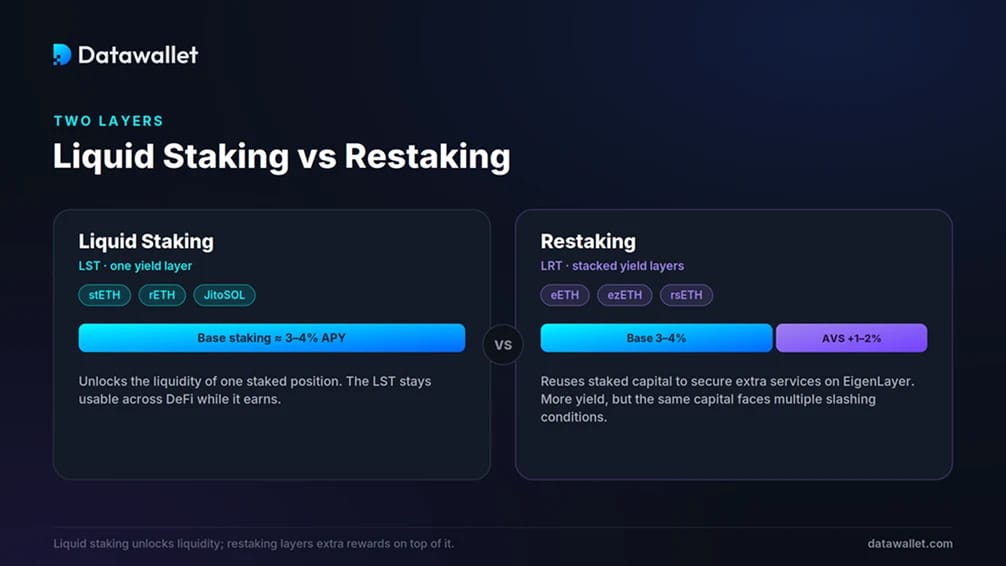
Pure Restaking (eigenETH, ezETH, rsETH): These tokens track your ETH stake directly while adding restaking rewards. They are generally safer if you want exposure to the EigenLayer ecosystem without additional yield farming complexity. The yield is transparent: base ETH staking (~2.8–3.2%) plus the "security premium" from Actively Validated Services (AVSs).
Hybrid Strategies (ethFI): Ether.fi’s native token combines liquid staking with restaking. This can offer higher yields but introduces double-layer smart contract risk and potential depeg volatility. Use this if you are comfortable with higher complexity for potentially higher returns.
For most new users, starting with a pure restaking token like eigenETH or ezETH is the recommended path. It keeps your exposure direct and your risk profile manageable while still capturing the benefits of the restaking economy.
Connect wallet and deposit ETH
Before you can participate in restaking derivatives, you must bridge or transfer ETH to a compatible Layer 2 network and connect your wallet to the protocol interface. This process requires careful attention to gas fees and network compatibility to avoid failed transactions or lost assets.
Choose your network and bridge
Most restaking protocols operate on Ethereum Layer 2 solutions like Arbitrum or Base to reduce transaction costs. If your ETH is on the Ethereum mainnet, use an official bridge or a trusted aggregator to move your funds to the target L2. Always verify the destination network in your wallet before confirming the transfer.
Connect your wallet
Go to the EigenLayer or EtherFi dashboard and click the "Connect Wallet" button. Select your preferred wallet provider, such as MetaMask or Rabby. Ensure your wallet is connected to the correct network (e.g., Arbitrum One) and that you have enough native ETH on that chain to cover gas fees for the upcoming deposit and approval transactions.
Approve and deposit ETH
Once connected, select the amount of ETH you wish to restake. The protocol will first prompt you to approve the token spend. Confirm this transaction in your wallet. Immediately after, confirm the deposit transaction. The interface will display your staked balance and expected yield metrics. Wait for both transactions to confirm on the blockchain before closing the interface.
Select active validation services
Choosing which Active Validation Services (AVSs) to join is the most critical decision in restaking. This choice determines your yield potential and, more importantly, your exposure to slashing risk. An AVS is a secondary protocol that rents security from EigenLayer validators. By participating, you earn additional rewards, but you also accept the responsibility of meeting that protocol’s specific requirements.
Think of your staked ETH as a security guard. When you select an AVS, you are assigning that guard to protect a new building. If the guard performs well, you get paid more. If they fail to protect the building—resulting in a "slashing" event—you lose a portion of your deposit. The more buildings (AVSs) you assign the same guard to, the higher the chance that a single failure could compromise all your assignments.
To manage this, start by reviewing the AVS’s technical documentation and historical performance. Prioritize services with clear, audited smart contracts and transparent operator requirements. Avoid AVSs that promise unusually high yields without corresponding security audits, as these often indicate hidden risks or unsustainable models. Always verify the AVS’s status on official EigenLayer or protocol-specific dashboards before committing capital.
Monitor slashing and yield metrics
Tracking your restaking derivatives position requires watching two distinct signals: the yield accrual rate and the network health status. EigenLayer and EtherFi provide official dashboards that aggregate these metrics, allowing you to verify that your staked assets are performing as expected and remain secure against slashing events.
Start by checking the yield metrics on the EtherFi dashboard. The platform displays real-time APY data, which includes the base Ethereum staking reward and the additional "security premium" earned by restaking. As of early 2026, solo staking offers approximately 2.8–3.2% base yield, with restaking adding a specialized premium on top. Regularly monitoring this rate helps you understand if your position is outperforming standard liquid staking tokens or if market conditions are shifting.
Simultaneously, you must monitor the EigenLayer slasher dashboard to stay informed about network health. This tool tracks any active slashing events across the protocol. If a validator operator misbehaves, the slasher records the infraction, and your restaked assets may be penalized depending on the operator's configuration. Keeping an eye on this dashboard ensures you are aware of any potential risks to your capital.
Finally, use the TechnicalChart to visualize the correlation between ETH price movements and restaking yields. This live chart helps you contextualize your APY within the broader market environment, ensuring that your yield gains are not offset by significant price depreciation.
Managing exit liquidity and risks
Withdrawing restaked assets is not as simple as clicking a sell button. Because restaking derivatives like EigenLayer points or EtherFi eETH are locked to provide shared security, you must handle unbonding periods and potential liquidity gaps. Understanding these constraints is essential to avoid getting stuck in a position during market volatility.
Before initiating a withdrawal, verify your active Active Validator Set (AVS) commitments. EigenLayer requires you to explicitly opt-out of specific AVSs before the global unbonding period begins. If you remain attached to an AVS, your assets remain locked until that specific service’s exit queue clears, which can vary significantly in duration.
Submit the withdrawal transaction through your restaking interface, such as EigenLayer or EtherFi. This action triggers the start of the unbonding period. For EigenLayer, this is typically 7 days for native ETH, but it can be longer for liquid staking tokens depending on the underlying protocol’s specific rules. Ensure you have enough gas for this transaction and any subsequent steps.
During the unbonding window, your assets are transitionally locked. You cannot trade or use these assets while they are in the queue. This is a critical risk period; if the market crashes, your capital is immobilized. Some protocols offer secondary markets for early exit, but these often come with steep discounts, effectively reducing your yield.
Once the unbonding period expires, your assets are available to claim. You may need to bridge them to a different chain or wallet if you are moving out of the restaking ecosystem entirely. Verify the destination wallet address and network compatibility before finalizing the transfer to prevent permanent loss of funds.
-
Verify AVS opt-out status
-
Confirm unbonding period duration
-
Check gas availability for transactions
-
Review secondary market liquidity options
Mitigating impermanent loss and protocol risk requires active monitoring. Restaking derivatives often have lower liquidity than standard staked ETH, meaning selling large positions can slip the price. Additionally, smart contract risk is amplified because your assets secure multiple networks. If one AVS fails or is slashed, your entire restaked position could be penalized. Always diversify across different restaking protocols and keep a portion of your portfolio in highly liquid assets to cover sudden liquidity needs.
No comments yet. Be the first to share your thoughts!