
What restaking derivatives actually are
Restaking derivatives are financial instruments that extend the utility of staked assets beyond simple yield generation. At their core, they function as tokens representing a share of staked capital, allowing holders to access liquidity while maintaining exposure to network rewards. This mechanism transforms idle staked assets into active collateral, creating a layered financial ecosystem where capital can serve multiple security functions simultaneously.
Liquid staking derivatives (LSDs) represent the foundational layer of this architecture. An LSD, such as stETH or rETH, is issued when a user deposits native tokens into a staking protocol. The protocol stakes these assets on a Proof-of-Stake network and returns a derivative token that tracks the underlying value plus accrued staking rewards. This process solves the illiquidity problem inherent in traditional staking, where assets are locked for extended periods. Academic research into the economics of LSDs highlights how these tokens establish a basis against the underlying asset, driven by supply-demand dynamics and yield differentials [src-serp-1].
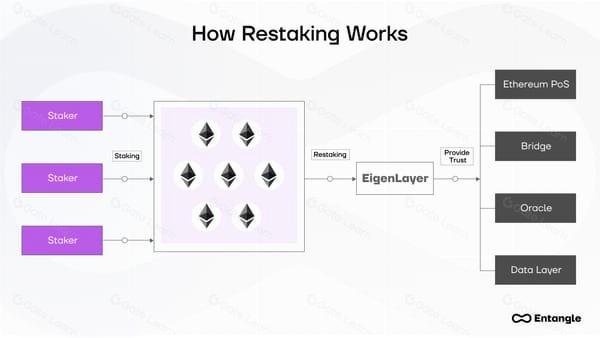
Restaking protocols build upon this foundation by allowing LSD holders to re-deposit their tokens to secure additional networks or services. Instead of resting in a single validator set, the capital is "restaked" to provide cryptographic assurance to secondary protocols, such as oracle networks or bridge validators. This creates a recursive yield structure: the original staking reward is combined with additional yield generated from securing these ancillary services. As noted in recent technical analyses, this leverage staking model significantly increases the capital efficiency of the Ethereum ecosystem [src-serp-2].
The distinction between simple staking and restaking is critical for risk assessment. Simple staking involves a single point of failure: the validator set securing the base layer. Restaking introduces composability but also amplifies systemic risk. If the underlying consensus layer is compromised, the security guarantees provided to all restaked services collapse simultaneously. Therefore, understanding the mechanical flow of restaking derivatives is not merely an academic exercise; it is a prerequisite for managing exposure in high-stakes crypto environments.
Leading liquid restaking tokens
Liquid restaking tokens (LRTs) have evolved from simple staking wrappers into complex financial primitives. In 2026, the market has consolidated around a few protocols that offer distinct yield pathways and risk profiles. These tokens allow holders to maintain liquidity while earning restaking rewards, but they introduce additional smart contract and slashing risks that require careful scrutiny.
Ether.fi
Ether.fi remains the largest LRT protocol by total value locked, leveraging a "node runner" model. Instead of relying on a single validator set, it distributes responsibilities across multiple node operators, which reduces single-point failure risks. Holders of eETH receive both Ethereum staking yields and EigenLayer restaking points. The protocol’s extensive audit history and large liquidity pools make it a standard benchmark for LRT performance, though its size exposes it to broader systemic risks within the EigenLayer ecosystem.
Renzo Protocol
Renzo focuses on capital efficiency through its EZ token, which automatically distributes rewards across multiple restaking strategies. Unlike protocols that lock users into specific operators, Renzo uses a dynamic allocation system to optimize yields based on current network conditions. This approach simplifies the user experience but relies heavily on the security of its underlying strategy managers. Renzo has undergone multiple independent audits, and its transparent reward distribution mechanism provides clear visibility into yield sources.
Puffer Finance
Puffer distinguishes itself with a "liquid restaking vault" model that allows users to deposit ETH directly into a vault that manages validator keys. This design reduces the complexity of managing separate staking and restaking positions. Puffer’s native token, PufETH, accrues rewards from both Ethereum consensus layer and restaking layers. The protocol emphasizes security through its modular architecture, which isolates different risk components. However, the complexity of its vault structure requires users to understand the specific slashing conditions associated with each restaking layer.
Kelp DAO
Kelp DAO offers a decentralized approach to restaking through its rETH token, which integrates with the EigenLayer ecosystem. Kelp’s governance model allows token holders to vote on risk parameters and operator selections, providing a layer of community oversight. The protocol has been audited by several leading security firms, and its focus on decentralization appeals to users concerned about centralization risks in restaking. Kelp’s yield is derived from both staking rewards and restaking incentives, making it a competitive option for yield seekers.
Superfluid
Superfluid enables continuous payment streams for LRT rewards, allowing users to receive yield in real-time rather than at discrete intervals. This innovation addresses the liquidity constraints often associated with traditional staking rewards. By integrating with various LRT protocols, Superfluid provides a flexible infrastructure for yield distribution. The protocol’s focus on programmable money makes it a valuable tool for sophisticated DeFi users who require precise control over their cash flows.
Strategies for maximizing yield efficiency
Restaking derivatives offer more than passive yield accumulation; they provide the infrastructure for active yield generation. By leveraging Liquid Restaking Tokens (LRTs) as collateral, operators can engage in complex DeFi strategies that compound returns beyond simple staking rewards. These approaches require a rigorous understanding of smart contract risk and market mechanics.
Basis Trading and Leverage Stacking
One of the most direct ways to extract value is through basis trading. Traders can utilize LRTs as collateral on lending protocols to borrow stablecoins, then deploy those assets into yield-bearing opportunities or short-futures markets to capture the spread between spot and futures prices. This strategy, often referred to as leverage stacking, amplifies returns but also magnifies exposure to liquidation events if the underlying asset price drops sharply.
Liquidity Provision with LRTs
Providing liquidity in decentralized exchanges (DEXs) using LRTs is another avenue for yield optimization. Because LRTs represent both staking yield and restaking points, they can be paired with stablecoins or other major assets to earn trading fees. However, impermanent loss remains a significant risk, particularly if the restaking protocol introduces volatility through point emissions or changes in consensus layer dynamics. Operators must monitor the correlation between the LRT and the paired asset closely.
Risk Management and Audit Status
The complexity of these strategies introduces layered smart contract risks. Every interaction—whether bridging, swapping, or providing liquidity—exposes capital to potential exploits. It is essential to verify the audit status of every protocol in the stack. As noted by Paradigm, staking derivatives are subject to similar market realities as MEV extraction, meaning their value is often extracted by sophisticated actors. Prioritizing protocols with multiple independent audits and a history of transparent security practices is not optional; it is fundamental to capital preservation.
Managing Ethereum restaking risks
Restaking Derivatives works best as a clear sequence: define the constraint, compare the realistic options, test the tradeoff, and choose the path with the fewest hidden costs. That order keeps the advice usable instead of decorative. After each step, pause long enough to check whether the recommendation still fits the reader's actual situation. If it depends on perfect timing, unusual access, or a best-case budget, include a simpler fallback.
The simplest way to use this section is to write down the real constraint first, compare each option against it, and choose the path that still works outside ideal conditions.
Frequently asked questions about restaking
What are the 4 types of derivatives?
In the context of restaking and liquid staking derivatives (LSDs), the primary instruments are swaps, futures, options, and forward contracts. LSDs themselves function as spot derivatives representing a claim on staked assets, but their utility in DeFi relies on these four standard financial structures to hedge risk or leverage yield. For instance, futures contracts allow protocols to lock in future prices for staked ETH, while options provide insurance against price volatility.
Why is restaking risky?
Restaking introduces smart contract risk and slashing risk that do not exist in simple holding. When you restake, your capital is often locked across multiple protocols; if one protocol’s validator behaves maliciously or fails an audit, your entire stake can be slashed. Unlike traditional staking, where penalties are isolated to the validator, restaking creates a web of interdependencies. A failure in a core restaking layer, such as EigenLayer, can cascade through dependent protocols, amplifying losses.
What is the most profitable staking crypto?
Profitability varies by market conditions, but Ethereum (ETH) remains the dominant asset for restaking due to its deep liquidity and established ecosystem of LSDs like stETH and rETH. While newer chains may offer higher nominal APYs, they often carry higher impermanent loss and smart contract risk. The most consistent yields come from combining native staking rewards with DeFi strategies that utilize the liquid derivative, though these yields are not guaranteed and fluctuate with network demand.
What is better, staking or a liquidity pool?
Staking is generally safer for long-term holders seeking passive income with lower complexity. Liquidity pools offer potentially higher yields but expose you to impermanent loss and smart contract vulnerabilities. Restaking sits between these two: it offers the security of staking while allowing the derivative to be used in liquidity pools or lending markets for additional yield, though this increases the attack surface.
No comments yet. Be the first to share your thoughts!