
What restaking derivatives actually are
Restaking derivatives are tokens that represent crypto-assets placed into staking, along with the rewards accrued on them. Unlike traditional staking, where assets are locked and illiquid, these derivatives allow holders to maintain exposure to their underlying crypto while using the token in other DeFi activities. This mechanism unlocks flexibility, enabling users to earn additional yield on top of their base staking rewards.
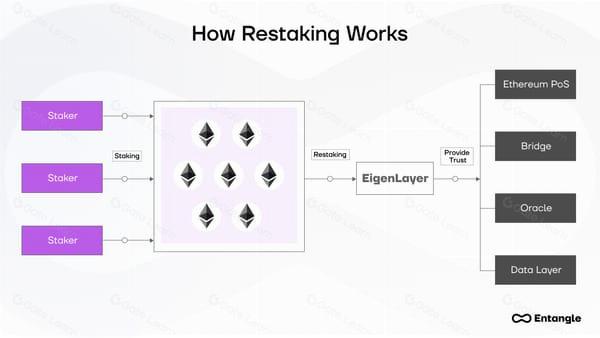
The core innovation of restaking derivatives lies in their layered nature. When you stake assets like ETH, you typically receive a liquid staking token (LST) in return. Restaking protocols then take this LST and restake it to secure additional networks or services, such as EigenLayer’s Actively Validated Services (AVSs). This creates a derivative of a derivative—a liquid restaking token (LRT)—which represents your position in this multi-layered security setup.
This structure introduces a complex yield stack. Your returns come from three potential sources: the base Ethereum staking yield, the restaking yield from securing AVSs, and any additional yield generated by deploying the LRT in liquidity pools or lending markets. However, this complexity is not without risk. Smart contract vulnerabilities, slashing events across multiple layers, and impermanent loss in DeFi positions can compound, potentially eroding principal.
Understanding this distinction is critical for risk management. Traditional staking offers a single layer of security and yield. Restaking derivatives offer amplified yields but expose the investor to a broader attack surface. The token you hold is not just a receipt for staked ETH; it is a claim on a complex web of cryptographic guarantees and economic incentives that must remain aligned for the strategy to succeed.
How EigenLayer V2 Changes the Architecture
EigenLayer V2 introduces structural modifications to the restaking protocol that fundamentally alter how liquid restaking tokens (LRTs) function. The shift moves the network away from a purely passive accumulation model toward a more active, risk-managed ecosystem. This transition requires a re-evaluation of yield strategies, as the underlying mechanics for slashing protection and operator delegation have been refined to address the fragility observed in early V1 deployments.
The core architectural change lies in the decoupling of staking yield from restaking risk. In V1, the integration of liquid staking derivatives (LSDs) and restaking was tightly bound, creating complex dependency chains. When an LSD validator was slashed, the impact rippled through all dependent restaking protocols. V2 introduces a modular risk layer that allows operators to opt into specific risk pools. This means an LRT provider can choose to expose capital to certain types of slashing events while maintaining protection against others, offering a more granular risk profile.
Economic incentives have also been recalibrated. The protocol now emphasizes "points" and reputation scores over simple yield maximization. Operators are incentivized to maintain high uptime and low error rates to earn higher multipliers on their restaking rewards. This reduces the incentive for "yield farming" behaviors that previously led to network instability. The result is a more stable, albeit potentially lower-yield, environment for long-term holders of restaking derivatives.
For investors, this means the strategy shifts from chasing the highest APY to selecting protocols with robust risk management frameworks. The technical sophistication of V2 demands a deeper understanding of the underlying smart contract interactions. As the protocol matures, the spread between LSD yields and restaking yields is expected to narrow, reflecting the true cost of the additional security services provided.
Top liquid restaking tokens by strategy
Liquid restaking tokens (LRTs) have evolved from simple staking wrappers into complex yield aggregators. In 2026, the market has fragmented into distinct strategy archetypes. Each protocol balances yield generation against specific risk vectors, primarily slashing exposure and smart contract complexity.
The following comparison outlines the major LRT protocols by market position and risk profile. These metrics reflect the current landscape of EigenLayer V2 integrations and independent restaking architectures.
| Protocol | Primary Asset | Yield Strategy | Primary Risk Factor |
|---|---|---|---|
| EigenLayer | ETH | Native EAL Restaking | Slashing exposure via active set |
| Ether.fi | ETH | ETHx + eETH Dual Token | Smart contract complexity |
| Renzo | ETH | ezETH + AVS Integration | AVS performance variance |
| Puffer | ETH | PufETH + Validator Pool | Custodial validator risk |
| Karak | ETH | kETH + Modular AVS | Cross-chain bridge exposure |
The table above highlights the divergence in risk management. Protocols like EigenLayer and Ether.fi rely heavily on the Ethereum ecosystem's native security, while newer entrants like Karak and Renzo introduce modular AVS (Actively Validated Services) layers. These additional layers can boost yields but introduce new vectors for smart contract failure.
Investors must distinguish between yield derived from consensus rewards versus yield derived from AVS contracts. The latter is inherently more volatile and carries higher smart contract risk. Always verify the specific slashing conditions for each protocol before allocating capital.
Key risks in layered staking derivatives
Layered staking derivatives amplify yield by stacking liquidity, but they also stack exposure. When a single validator node misbehaves, the penalty propagates through every protocol that relies on that node’s security. This is not theoretical; slashing events in 2024 demonstrated how quickly a single point of failure can drain yields across the entire restaking ecosystem.
Smart contract and slashing exposure
The most immediate threat is smart contract risk. Restaking protocols like EigenLayer introduce new codebases that must manage complex interactions between liquid staking tokens (LSTs) and EigenLayer Restaking Tokens (ERTs). Each additional layer increases the attack surface. If a contract fails to properly handle edge cases—such as rapid price fluctuations in the underlying LST—the protocol may become insolvent or frozen.
Slashing risk is equally severe. In a restaking context, validators stake their ETH and delegate it to multiple Actively Validated Services (AVSs). If a validator is slashed for double-signing or downtime on any one AVS, the penalty is deducted from the underlying staked ETH. This means a single error can trigger losses across all restaking positions that rely on that validator, not just the specific AVS where the infraction occurred. This "double slashing" potential creates a systemic risk that traditional staking does not face.
Basis risk and liquidity traps
Beyond technical failures, basis risk remains a persistent concern. The price of a restaking derivative often trades at a discount to its underlying asset due to market sentiment, liquidity constraints, or fear of slashing. If the market turns negative, this discount can widen rapidly, forcing holders to sell at a loss if they need liquidity. Unlike simple staking, where you hold the underlying asset, restaking derivatives are complex instruments whose value depends on the health of multiple underlying protocols.
Liquidity traps can also occur during periods of high volatility. If many users attempt to redeem their restaking tokens simultaneously, the protocol may struggle to provide liquidity, especially if the underlying LSTs are also experiencing redemption delays. This creates a feedback loop where fear drives selling, which drives down prices, which triggers more selling. Investors must carefully monitor the liquidity depth of both the LST and the restaking derivative to avoid being caught in a trap.
Mitigation strategies
To navigate these risks, investors should diversify across multiple validators and AVSs to avoid single points of failure. Regularly auditing the smart contracts involved and monitoring on-chain metrics for unusual activity can provide early warning signs of trouble. Additionally, maintaining a portion of capital in non-restaked liquid assets provides a buffer against basis risk and liquidity crunches. Understanding the specific slashing conditions of each AVS is crucial, as penalties vary significantly based on the service’s security requirements.
Frequently asked questions about restaking
Is staking a derivative?
Staking itself is a consensus mechanism, not a derivative. A staking derivative is a token representing the underlying staked asset and its accrued rewards, issued by liquid staking protocols when a user locks their assets.
Can I lose crypto when staking?
Yes. While staking yields rewards, slashing penalties from protocol errors or validator misconduct can reduce your principal. Restaking compounds this risk by exposing your assets to multiple layers of smart contract and consensus failure.
What are the types of staking?
Staking is generally custodial or noncustodial. Custodial staking requires transferring tokens to a platform, while noncustodial staking allows you to keep your staked coins in your own digital wallet, retaining full control.
No comments yet. Be the first to share your thoughts!