
Understand restaking mechanics
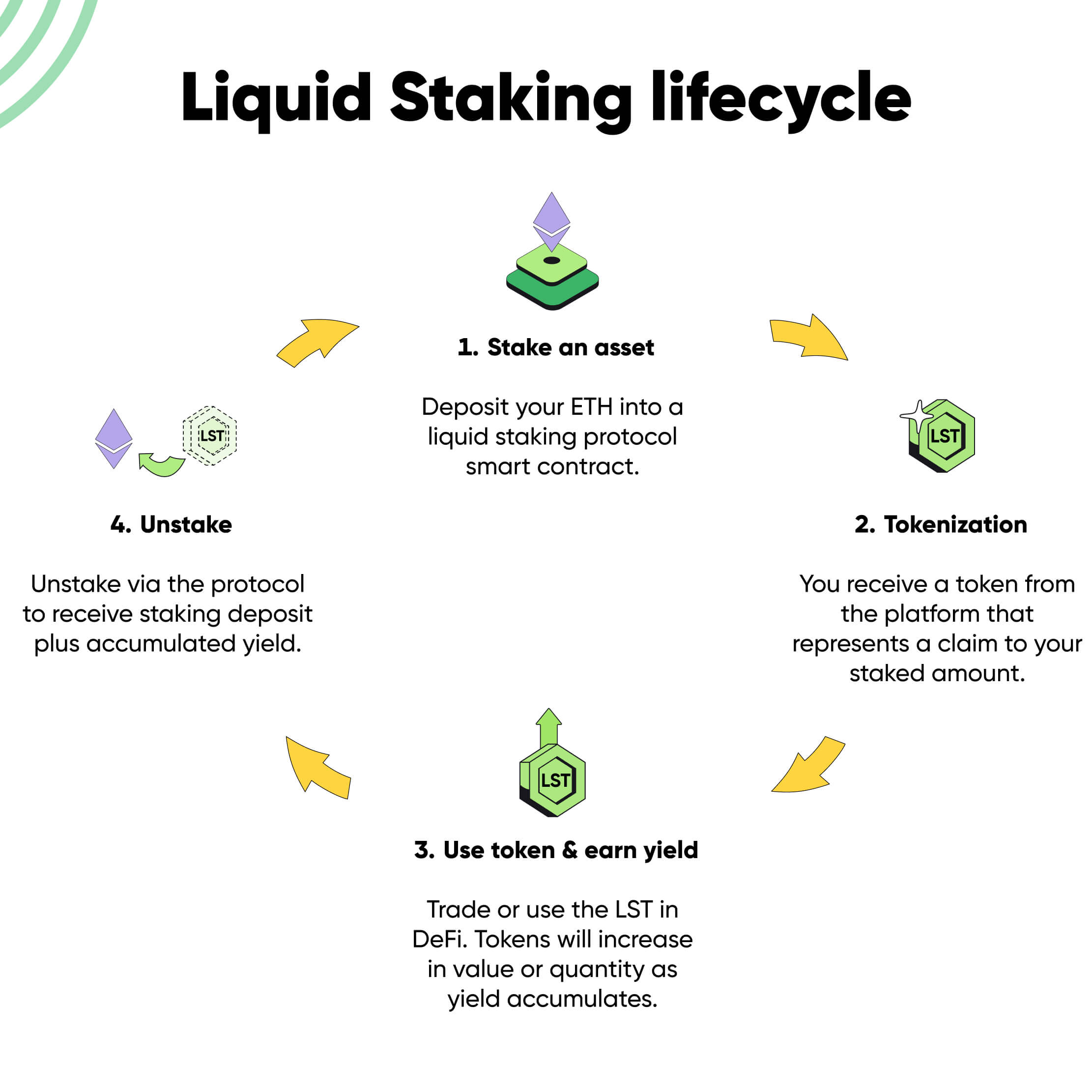
To use restaking derivatives safely, you first need to distinguish between staking, liquid staking, and restaking. These terms describe a hierarchy of security and liquidity, not separate asset classes.
Staking is the base layer. You lock your crypto (like ETH) to help secure the blockchain and earn rewards. Your assets are locked, and you lose access to them during the staking period.
Liquid staking solves the liquidity problem. You deposit your crypto and receive a derivative token (like stETH) in return. This token represents your staked asset and can be traded or used in other DeFi protocols while still earning staking rewards. However, this derivative only secures the original network.
Restaking takes that liquid staking derivative and locks it again to secure additional networks. Instead of just protecting the base blockchain, your cryptographic security proofs are reused to validate other protocols, such as oracles or bridge networks. This allows a single asset to provide security for multiple services simultaneously, often generating extra rewards in the process.
Restaking is not yield farming; it is re-using cryptographic security proofs to secure additional networks.
The diagram below illustrates how these layers build on each other, moving from simple staking to the more complex structure of restaking derivatives.
Select a restaking protocol
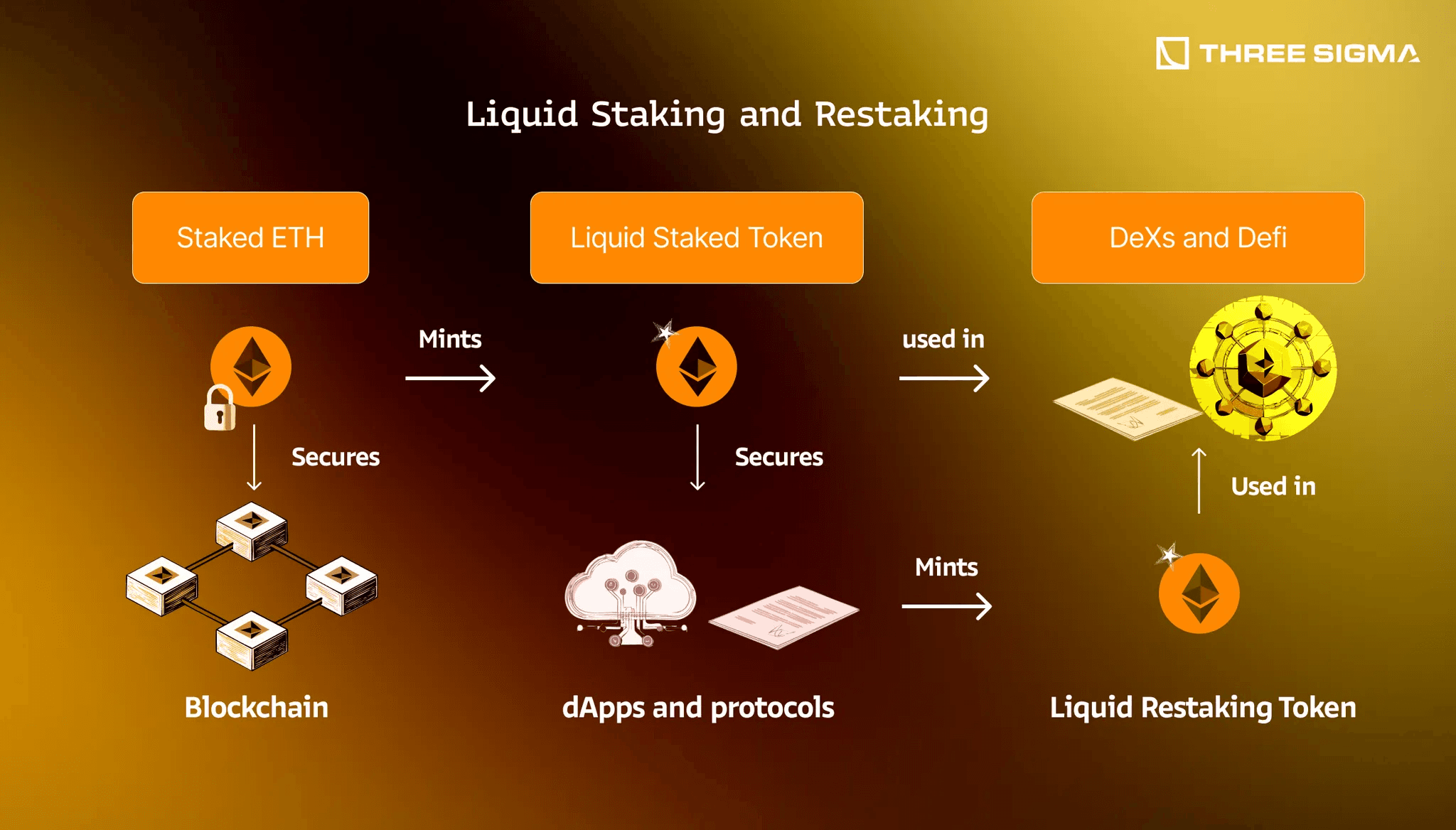
Choosing the right protocol determines your risk exposure and yield potential. With the liquid restaking market estimated at $30 billion in TVL as of 2025, the options have expanded beyond a single dominant player. You need to evaluate protocols based on three core metrics: Total Value Locked (TVL) for liquidity depth, security audit history for code reliability, and the active Operator set for decentralization.
Start by comparing the major protocols side-by-side. The table below outlines the current standing of the leading platforms based on available public data. Prioritize protocols with a longer track record of security audits and a diverse set of active operators to minimize single-point-of-failure risks.
| Protocol | Est. TVL | Audit Status | Active AVSs |
|---|---|---|---|
| EigenLayer | $10B+ | Multiple (Trail of Bits, etc.) | >20 |
| Renzo | $1.5B+ | Multiple | EigenLayer-based |
| Kelp DAO | $1B+ | Multiple | EigenLayer-based |
| Puffer Finance | $800M+ | Multiple | EigenLayer-based |
Once you have selected a protocol, verify the specific security assumptions. Most liquid restaking derivatives (LRDs) rely on the underlying Ethereum security, but the operator layer introduces additional variables. Check the protocol’s official documentation for their slashing conditions and insurance mechanisms. Avoid protocols with vague audit reports or a highly concentrated operator set, as these increase the risk of coordinated attacks.
For a broader view of the market landscape, refer to the latest DeFi reports from reputable analytics firms. The restaking sector continues to evolve rapidly, so always check the most recent data on TVL and active validators before deploying capital.
Deposit and mint LRTs
To receive Liquid Restaking Tokens (LRTs), you must deposit your existing Liquid Staking Tokens (LSTs) into a restaking protocol. This process converts your staked assets into a new token that represents your dual-layer staking position. The most common path involves depositing tokens like stETH or rETH into a protocol such as EigenLayer.
Navigate to the official dashboard of your chosen restaking protocol. Ensure you are on the correct website to avoid phishing scams. Click the wallet connection button and authorize the link with your Web3 wallet, such as MetaMask or Rabby.
Before depositing, the protocol needs permission to move your LSTs. Select the token you wish to restake (e.g., stETH) and click "Approve." A transaction will appear in your wallet; confirm it and wait for the blockchain to process the approval. This step is required only once per token type.
Enter the amount of LSTs you want to restake and click "Deposit." This action locks your tokens into the protocol’s smart contract. The contract will immediately mint the corresponding LRTs (such as eETH or rsETH) and send them to your wallet. You now hold the LRT, which accrues rewards from both the original staking and the restaking activity.
Restaking derivatives allow you to earn additional yield by securing multiple networks simultaneously. Always verify the contract address on the protocol’s official documentation before interacting with the UI.
Manage slashing and smart contract risk
Restaking amplifies rewards, but it also layers risk. When you restake, your assets secure multiple networks simultaneously. If a validator misbehaves on any of those networks, the penalty can cascade. You must understand the specific slashing conditions and smart contract vulnerabilities before depositing.
Understand slashing conditions
Slashing is the penalty for validator misbehavior, such as double-signing or prolonged downtime. In a restaking context, this risk is magnified. Your stake is often shared across multiple protocols. A single infrastructural failure or malicious act can trigger penalties on all connected networks at once.
Check the specific slashing policies of each protocol you engage with. Some protocols may have insurance funds or insurance mechanisms to mitigate losses, while others pass the full risk to the staker. Read the documentation carefully to see how penalties are calculated and distributed.
Warning: Restaking amplifies rewards but also amplifies slashing risks. Ensure you understand the penalty structure before depositing.
Assess smart contract vulnerabilities
Smart contracts are immutable once deployed. If a vulnerability is found, funds can be lost permanently. Restaking protocols involve complex interactions between liquid staking tokens, restaking contracts, and operator nodes. This complexity increases the attack surface.
Look for audit reports from reputable firms. Check if the protocol has a bug bounty program. Verify if the code has been live for a significant period without major incidents. Prefer protocols with transparent governance models that allow for rapid upgrades in case of emergencies.
Diversify operators
Don't put all your restaked assets with a single operator. Diversifying across multiple operators reduces the impact of any single operator's failure or malicious behavior. Check the track record and reputation of each operator. Avoid operators with a history of downtime or slashing events.
Monitor your positions regularly. Use dashboards provided by the protocols to track performance and risk metrics. Set up alerts for any unusual activity or changes in slashing conditions.
Optimize yield and liquidity
Liquid restaking tokens (LRTs) are designed to be used, not held. Once you receive your LRT, it acts as a versatile asset that can be deployed across multiple DeFi protocols to generate additional yield. This process, often called "yield stacking," allows you to earn restaking rewards while simultaneously capturing liquidity mining incentives or lending interest.
Before deploying your LRTs, ensure you understand the specific risks. Each protocol you interact with introduces smart contract risk, and combining positions can amplify losses if the underlying staked assets are slashed. Always verify that the protocol has been audited and that the LRT you are using is supported.
Use LRTs as Collateral
One of the primary utilities of LRTs is their ability to serve as collateral in lending markets. By depositing your LRT into a lending protocol, you can borrow stablecoins or other assets without selling your position. This unlocks liquidity while allowing your original stake to continue earning restaking rewards.
When using LRTs as collateral, pay close attention to the loan-to-value (LTV) ratio. LRTs may have different volatility profiles compared to standard staked ETH, so protocols might apply a haircut to the collateral value. Monitor your position closely to avoid liquidation if the value of your LRT drops significantly relative to the borrowed asset.
Provide Liquidity
You can also provide liquidity in decentralized exchanges (DEXs) using your LRTs. Common pairs include LRT/ETH or LRT/stablecoin pools. Liquidity provision can generate trading fees and additional token incentives, potentially boosting your overall yield significantly.
However, impermanent loss is a real risk when providing liquidity. If the price of your LRT diverges from the paired asset, you may end up with a less valuable portfolio than if you had simply held the assets. Consider using concentrated liquidity pools if the protocol supports them, as they offer more capital efficiency but require active management.
Verify Audit Status and Slashing Conditions
Before committing funds to any yield strategy, perform a due diligence checklist. Ensure the LRT protocol has undergone independent security audits and that the lending or DEX protocol you are using is reputable. Additionally, confirm the slashing conditions associated with the restaking protocol. If the validator set is slashed, your LRT value may drop, affecting your collateral position or liquidity pool share.
-
Verify LRT protocol audit reports
-
Check lending protocol LTV ratios for LRTs
-
Confirm slashing risk coverage
-
Assess impermanent loss potential
By carefully selecting protocols and monitoring your positions, you can effectively leverage LRTs to maximize yield and liquidity in the DeFi ecosystem.
Restaking derivatives 2026 FAQ
This section addresses specific questions about the mechanics of restaking derivatives and the 2026 market outlook.
No comments yet. Be the first to share your thoughts!