
Restaking derivatives 2026 market snapshot
The restaking sector has evolved from a niche experiment into a multi-billion-dollar infrastructure layer. By late February 2026, the broader market held approximately $13.45 billion in total value locked (TVL), generating over $527,000 in daily fees. This capital has shifted from simple liquid staking toward complex derivative yield strategies, where assets like eETH and rETH are leveraged across multiple protocols to capture a "security premium" on top of base Ethereum yields.
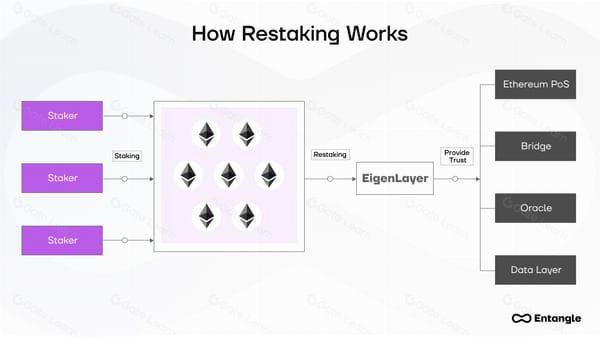
At the foundation of this ecosystem is Ethereum itself. As of March 2026, solo staking offers a base yield of roughly 2.8% to 3.2%. Restaking derivatives layer additional yield on top of this foundation by reusing the staked ETH to secure other networks, such as oracles or rollups. This creates a higher-risk, higher-reward environment where capital efficiency is maximized, but so is the exposure to smart contract and slashing risks.
The performance of these derivatives is tightly coupled with the underlying asset. The chart below tracks Ethereum’s price action, which serves as the primary benchmark for restaking returns. When ETH appreciates, the collateral value of restaked positions increases, allowing for greater leverage in the derivative market. Conversely, a downturn in ETH price can trigger rapid liquidations in leveraged restaking positions, highlighting the fragile balance between yield and risk.
How EigenLayer and Pectra drive yield
Use this section to make the Restaking Derivatives decision easier to compare in real life, not just on paper. Start with the reader's actual constraint, then separate must-have requirements from details that are merely nice to have. A practical choice should survive normal use, maintenance, timing, and budget. If a recommendation only works in an ideal situation, call that out plainly and give the reader a fallback path.
The simplest way to use this section is to write down the must-have criteria first, then compare each option against those criteria before weighing nice-to-have features.
Compare top liquid restaking tokens
Restaking isn't a single product; it's a fragmented market where protocol design dictates your risk profile. Ether.fi leads the sector by volume, but Renzo and Kelp DAO offer distinct advantages depending on whether you prioritize yield aggregation or capital efficiency. Choosing the wrong vehicle can lock your capital in low-yield or high-risk vaults.
The table below breaks down the core mechanics of the major players. We use live data for price action, but TVL and APY figures are indicative of current protocol states and fluctuate with Ethereum's base staking rewards and restaking demand.
| Protocol | Underlying Asset | Key Feature | Risk Profile |
|---|---|---|---|
| Ether.fi | ETH / eETH | Native restaking via EIGP points | Medium (Protocol smart contract risk) |
| Renzo | ETH / ezETH | LRT Vault strategy (auto-compounding) | Medium-High (Delegated strategy risk) |
| Kelp DAO | ETH / rETH | Liquid restaking with minimal fees | Medium (Standard LRT risk) |
| Puffer | ETH / pufETH | Fraud-proof based liquid restaking | Medium (Complexity risk) |
The trade-off: Yield vs. Complexity
Higher yields in LRTs rarely come from "free" money; they come from taking on additional layers of smart contract risk or delegating to third-party validators. Ether.fi’s model is straightforward: you stake ETH, get eETH, and earn points for potential airdrops. The yield is primarily the base Ethereum staking reward (~3-4%).
Renzo’s ezETH takes a different approach. It doesn't just restake; it automatically allocates your stake to high-yield strategies across multiple protocols. This can boost effective APY, but it introduces "delegated strategy risk." If one of the underlying protocols fails or gets slashed, your ezETH value is exposed. You are trading simplicity for potential alpha.
Live Market Data
LRT prices often trade at a discount or premium to their underlying ETH depending on market sentiment toward the specific protocol's security. Use the widget below to track real-time ETH performance, as LRTs generally correlate but may diverge during periods of network stress.
Slashing Risks and Systemic Exposure
Restaking amplifies yield, but it also concentrates risk. When you delegate your ETH to EigenLayer and then to Liquid Restaking Tokens (LRTs), you are not just securing the base layer; you are securing multiple Actively Validated Services (AVSs) simultaneously. If any of these services require signature verification or validation duties, a single misbehavior by the underlying validator can trigger a slashing event. The consequence is immediate: a portion of your staked ETH is burned, and your position is ejected from the protocol.
The danger lies in correlation. Most restaking strategies involve depositing the same underlying ETH across multiple LRT protocols to maximize yield. If one protocol suffers a critical bug or a validator misbehaves, the resulting slashing can cascade through the entire restaking ecosystem. This creates a systemic exposure where the failure of a single component can degrade the value of the entire sector, not just the individual protocol.
To monitor this risk, you must track both the health of the base layer and the specific AVSs you are supporting. The Ethereum network itself is the primary source of truth for slashing events, but LRT protocols often provide their own dashboards for validator performance. Understanding the interplay between these layers is essential for managing your exposure.
Bitcoin restaking vs Ethereum restaking
Bitcoin and Ethereum restaking share a core mechanic—locking assets to secure external services—but they operate in fundamentally different economic and security environments. Ethereum’s restaking ecosystem, anchored by EigenLayer, relies on the network’s vast validator set and established slashing conditions. Bitcoin’s emerging sector, led by protocols like Babylon and SolvBTC, attempts to apply similar security-sharing models to a network that was never designed for smart contracts or liquid staking derivatives.
The yield profiles reflect these structural differences. Ethereum restaking offers a "security premium" on top of base staking yields, which currently sit around 2.8% to 3.2% for solo staking. This premium compensates validators for acting as a shared security layer for other protocols. Bitcoin restaking, however, often targets higher yields by leveraging the scarcity of BTC as collateral for Bitcoin-backed derivatives or lending markets. This creates a higher risk-reward balance, where the underlying security model is still maturing compared to Ethereum’s battle-tested slashing infrastructure.
Risk management differs sharply between the two. Ethereum’s security model is integrated into the consensus layer; misbehavior is punished directly through validator slashing. Bitcoin restaking protocols often rely on cryptographic proofs or over-collateralization rather than native slashing, introducing counterparty and smart contract risks that are less prevalent in the Ethereum ecosystem. Investors must weigh the higher potential yields of BTC restaking against the relative immaturity of its security guarantees.
Frequently asked questions about restaking
Can you still mine Ethereum in 2026?
No. Ethereum mining ended permanently on September 15, 2022, when the network transitioned to Proof of Stake. The era of GPU mining for ETH is over. Today, securing the network requires staking existing ETH or providing computational resources through restaking protocols like EigenLayer, not traditional mining hardware.
What will 1 ETH be worth in 2026?
Price forecasts vary wildly, but major institutions remain cautious. Standard Chartered predicts Ethereum will reach $4,000 by the end of 2026, after dipping to $1,400 mid-year. Other analysts, such as Changelly, project a more modest $1,725 by June 2026. These numbers are speculative; restaking yields depend on protocol performance, not just token price.
Will Ethereum hit $50,000?
A $50,000 ETH price tag is currently considered unlikely for 2026. Most institutional forecasts, including those from Standard Chartered, cap expectations around $4,000–$5,000. While Bitcoin is projected to reclaim $100,000, Ethereum’s path is constrained by its massive circulating supply and the competitive yield landscape introduced by restaking derivatives.
What if you bought $1,000 of Ethereum 5 years ago?
Historical performance highlights the risk of holding versus staking. If you bought $1,000 of ETH in 2020, your investment would be worth approximately $11,145 today, depending on exact entry points. However, this static gain pales compared to the potential compounded yields available through active restaking strategies, which can significantly alter long-term portfolio performance if executed correctly.
No comments yet. Be the first to share your thoughts!