
How restaking derivatives 2026 mechanics work
Restaking derivatives 2026 represent a structural shift in how Ethereum validators generate yield. Instead of treating staking as a one-time security deposit, these protocols allow validators to reuse their Ethereum (ETH) collateral across multiple layers of decentralized infrastructure. This mechanism creates a new asset class: the liquid restaking token (LRT). By layering security services on top of native staking, validators can capture additional "security premiums" that were previously inaccessible.
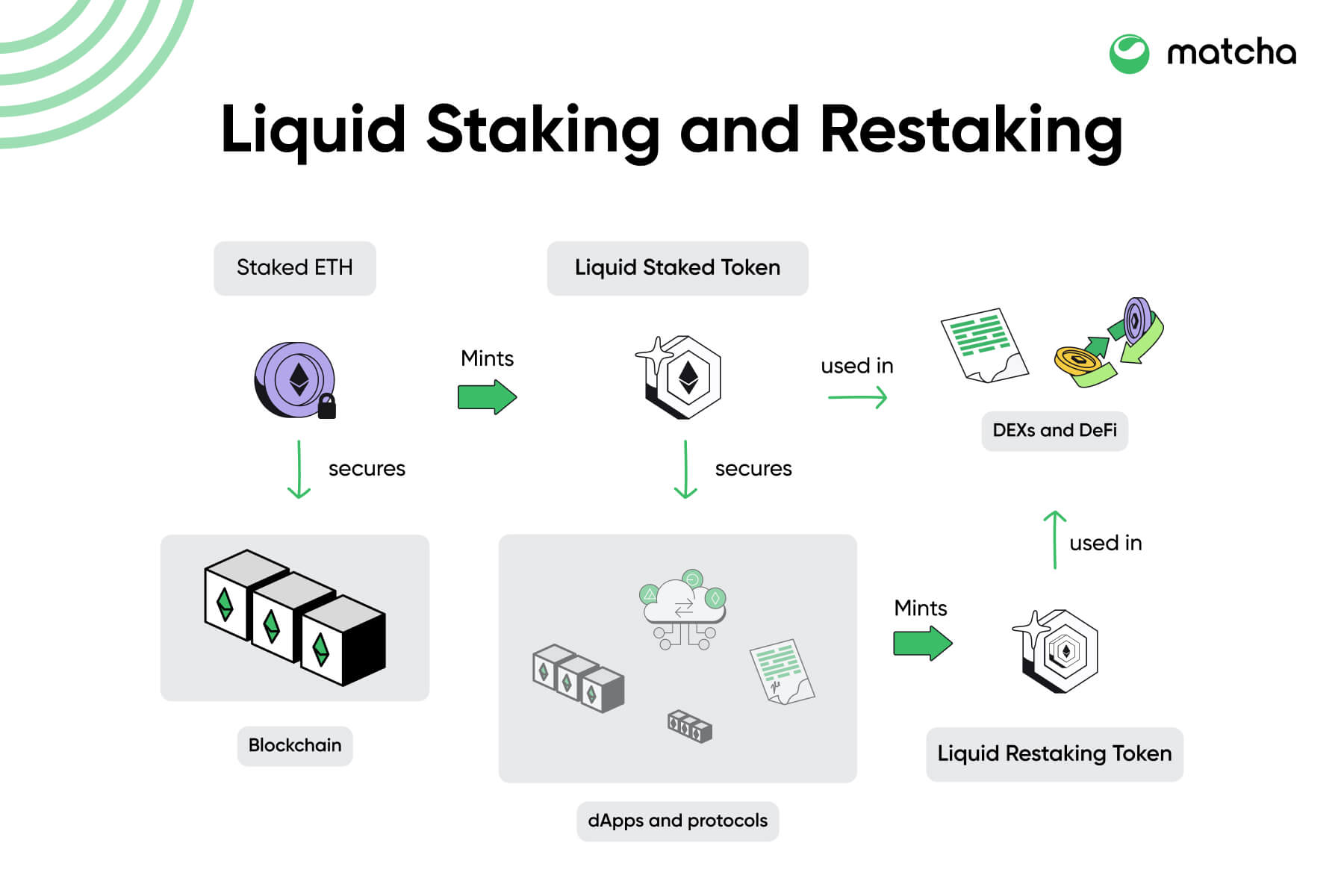
The process begins with native staking, where validators lock ETH to secure the Ethereum consensus layer. In 2026, solo staking yields typically range between 2.8% and 3.2% annually. Restaking protocols then issue LRTs to represent this staked position, allowing the underlying ETH to be delegated to secondary services like oracle networks, bridge validators, or decentralized compute providers. These services pay a premium for the security guarantee, which flows back to the LRT holder.
This layering effect amplifies yield but introduces complex risk vectors. The primary mechanism relies on smart contract abstraction; if a secondary service fails or is exploited, the original ETH collateral is often at risk. Therefore, the yield spread between native staking and restaking derivatives is essentially a risk-adjusted premium for providing this multi-layered security.
The LRT model solves the liquidity problem inherent in traditional staking. While native staked ETH is locked and illiquid, LRTs can be traded, used as collateral in lending markets, or deployed in yield farming strategies. This liquidity premium is a key driver of demand for restaking derivatives in 2026, transforming static security deposits into active financial instruments.
Native vs. restaking yield delta
The yield gap between native staking and restaking derivatives 2026 strategies is defined by the "security premium." This premium represents the additional compensation validators and restakers receive for providing extra cryptographic assurances to other networks, such as EigenLayer or Jito. While native staking offers a baseline return, restaking derivatives layer on top of this foundation, capturing value from multiple protocols simultaneously.
As of March 2026, Ethereum solo staking yields approximately 2.8% to 3.2% annually. Restaking protocols add a specialized premium on top of this base, effectively monetizing the same security capital twice. This structure allows capital to earn from the underlying consensus layer while also participating in the economic activity of restaked services. The delta between these two figures is the core metric for evaluating restaking efficiency.
To visualize the current market context and calculate potential returns, we track live asset prices alongside yield comparisons. The following table breaks down the base yield, LRT (Liquid Restaking Token) yield, and net APY for major restaking protocols.
| Metric | Native Staking | Restaking Derivatives | Yield Delta |
|---|---|---|---|
| Base Yield | 2.8% - 3.2% | 2.8% - 3.2% | 0% |
| Security Premium | 0% | 1.5% - 4.0% | +1.5% - 4.0% |
| Net APY | ~3.0% | ~4.5% - 7.0% | +1.5% - 4.0% |
| Risk Profile | Low | Medium-High | Higher |
The comparison highlights that while the base yield remains identical, the net APY for restaking derivatives 2026 strategies is significantly higher. However, this comes with increased complexity and smart contract risk. Investors must weigh the 1.5% to 4.0% yield delta against the potential for slashing events across multiple protocols. The security premium is not free money; it is compensation for extending trust beyond the base layer.
Bitcoin vs Ethereum Restaking Models
Restaking derivatives 2026 operate on two distinct architectural tracks. Ethereum’s model, anchored by EigenLayer, leverages a mature Proof-of-Stake infrastructure to offer "restaking"—a process where validators reuse their staked ETH to secure additional protocols. This creates a layered security market but introduces complex slashing risks for operators. Bitcoin’s approach is fundamentally different. Because Bitcoin lacks a native smart contract layer, protocols like Babylon and Solv must build external verification layers to enable restaking, focusing primarily on securing Bitcoin’s massive capital base rather than expanding a general-purpose execution environment.
The Ethereum ecosystem treats restaking as an extension of existing validator duties. When you restake ETH, you are essentially signing up to enforce the rules of multiple new protocols simultaneously. This amplifies yield but also concentrates risk. If a validator behaves maliciously on any of the secured networks, they can be slashed, losing their underlying stake. This mechanism has driven significant growth in Liquid Restaking Tokens (LRTs), which allow users to maintain liquidity while participating in this high-stakes security delegation.
Bitcoin restaking, by contrast, isolates the staked asset from the active execution layer. Protocols such as Babylon allow Bitcoin holders to stake their BTC to secure other Proof-of-Stake chains without moving their BTC into a smart contract. Solv and similar platforms offer liquid Bitcoin restaking products that generate yield from Bitcoin’s security premium. This model appeals to holders who want to earn yield on their dormant BTC without exposing it to the smart contract risks inherent in Ethereum’s restaking ecosystem. The tradeoff is clear: Ethereum offers deeper integration and higher potential yields through complex composability, while Bitcoin offers a more isolated, capital-efficient yield stream with different risk parameters.
Slashing Risks and Smart Contract Exposure
Restaking derivatives 2026 introduce a complex layer of security tradeoffs that do not exist in traditional staking. When you delegate your staked ETH to a Liquid Restaking Token (LRT) protocol, you are not just securing the Ethereum network; you are simultaneously securing multiple Actively Validated Services (AVSs). This creates a unique risk profile where a single validator node can be held accountable for failures across multiple distinct protocols.
Correlated Slashing Events
The most immediate danger in restaking is correlated slashing. In isolated staking, a penalty affects only your Ethereum stake. In restaking, if a validator misbehaves on any connected AVS—such as failing to provide data or signing invalid blocks—the slashing penalty is applied to the underlying Ethereum stake. Because many LRTs pool assets, a single operator's error can slash the collateral backing thousands of users' tokens.
This correlation amplifies systemic risk. If a major AVS suffers a vulnerability or a validator goes offline, the penalty ripples through the entire restaking ecosystem. Users may find their assets frozen or reduced not because of an Ethereum protocol error, but due to a failure in a secondary service they indirectly supported.
Smart Contract Vulnerabilities
Beyond slashing, restaking introduces significant smart contract exposure. LRT protocols are essentially complex financial contracts that manage the delegation, rewards, and withdrawal processes of staked assets. These contracts are often newer and less battle-tested than core Ethereum protocols, making them prime targets for exploits.
A vulnerability in an LRT's smart contract could lead to a total loss of deposited funds, independent of slashing events. The complexity of managing cross-protocol interactions increases the attack surface. Unlike native staking, where the risk is primarily operational (validator performance), restaking adds the risk of code failure, which can be catastrophic and irreversible.
The Tradeoff: Yield vs. Security
The higher yields offered by restaking derivatives are a direct compensation for these added risks. You are being paid for the additional security burden you take on and the exposure to smart contract vulnerabilities. Before allocating capital to LRTs, it is essential to understand that you are not just earning yield; you are underwriting the security of multiple protocols.
Choosing an LRT strategy for 2026
Selecting the right restaking derivative requires aligning protocol risk with your portfolio objectives. Liquid staking derivatives (LSTs) and Liquid Restaking Tokens (LRTs) offer distinct tradeoffs between yield potential and exposure to smart contract or slashing risks. Your strategy should prioritize capital preservation if you are risk-averse, or maximize yield if you are comfortable with higher volatility.
Conservative Allocation: Pure LSTs
For investors seeking to maintain exposure to Ethereum's base yield without additional restaking risk, pure Liquid Staking Tokens are the optimal choice. These derivatives allow you to earn staking rewards while retaining liquidity for other DeFi activities. This approach minimizes exposure to the complex smart contract layers introduced by restaking protocols, making it suitable for conservative portfolios or corporate treasuries focused on capital safety.
Aggressive Allocation: LRTs
If your goal is to maximize yield, Liquid Restaking Tokens (LRTs) provide exposure to both staking rewards and restaking yields. By restaking your LSTs, you can earn additional rewards from networks like EigenLayer. However, this strategy increases your attack surface and potential slashing risk. LRTs are best suited for high-risk-tolerance investors who understand the technical nuances of restaking and are willing to accept higher volatility for enhanced returns.
Balanced Approach: Hybrid Strategies
A balanced strategy involves allocating a portion of your portfolio to LRTs while keeping the remainder in pure LSTs. This hybrid approach allows you to capture some of the higher yields from restaking while maintaining a buffer against potential protocol failures. It is a pragmatic way to manage the evolving landscape of restaking derivatives 2026, ensuring that your portfolio remains diversified and resilient.
ETH Price Context
| Derivative | Yield Source | Risk Level |
|---|---|---|
| LST | Staking Rewards | Low |
| LRT | Staking + Restaking | High |
Frequently Asked Questions About Restaking Derivatives 2026
Can you still mine Ethereum in 2026?
No. Ethereum mining ended permanently on September 15, 2022, following the transition to Proof of Stake. The network no longer supports energy-intensive mining, shifting all security and yield mechanisms to staking and restaking derivatives instead.
What will 1 ETH be worth in 2026?
Market forecasts for Ethereum in 2026 are dynamic and depend on broader crypto trends. Rather than relying on static predictions, investors should monitor live market data to assess current valuations and potential growth trajectories for the asset.
What are the primary risks of LRTs?
Restaking introduces smart contract risk, slashing penalties, and liquidity fragmentation. While yields can be attractive, the complexity of layered derivatives means that protocol failures or validator errors can lead to significant capital loss.
No comments yet. Be the first to share your thoughts!