
Restaking derivatives 2026 explained
Restaking derivatives represent the maturation of shared security models in the Ethereum ecosystem. By 2026, the distinction between traditional staking and restaking has become critical for understanding yield generation and risk exposure. The core mechanism allows validators to reuse their staked ETH to secure additional decentralized infrastructure, effectively multiplying the utility of a single asset.
Liquid Restaking Tokens (LRTs) have emerged as the primary interface for this process. Unlike Liquid Staking Tokens (LSTs), which simply tokenize staked ETH for liquidity, LRTs represent a layer of active participation in the restaking protocol. When you stake ETH to receive an LST, you are securing the Ethereum network. When you restake that LST, you are extending that security to other protocols, such as oracle networks or bridge validators. This creates a hierarchical security model where Ethereum’s consensus power underpins a broader web of decentralized services.
The 2026 landscape is defined by this separation. Early restaking experiments were often opaque, but current protocols enforce clearer smart contract boundaries. Validators must explicitly opt-in to restake their LSTs, and the resulting LRTs can be traded or used in DeFi positions. However, this introduces a new variable: smart contract risk. If a restaking protocol is compromised, the underlying staked ETH is at risk, unlike native solo staking where the validator’s own keys and hardware are the only points of failure.
Yield in this sector comes from two sources: base Ethereum staking rewards and additional incentives from the protocols secured by the restaked ETH. These incentives vary widely and can be volatile. In 2026, the focus has shifted from chasing high APYs to evaluating the robustness of the security layer. Protocols that offer sustainable yields backed by real usage data are gaining traction, while those relying on token emissions are seeing reduced TVL.
EigenLayer and Ethereum LRTs
EigenLayer established the foundational infrastructure for Ethereum restaking, shifting the consensus model from isolated validator sets to shared security. By allowing staked ETH to be "restaked" across multiple Actively Validated Services (AVSs), the protocol created a mechanism for capital efficiency that traditional proof-of-stake networks lacked. This architecture enables a single unit of ETH to secure multiple networks simultaneously, though it introduces complex risk vectors regarding slashing conditions and operational responsibility.
Liquid Restaking Tokens (LRTs) emerged as the primary interface for this infrastructure, abstracting the technical complexity of running validator nodes. Protocols like Ether.fi and Renzo issue tokens such as eETH and rzETH, which represent restaked positions while maintaining liquidity. These derivatives allow users to retain exposure to ETH price appreciation and base staking yields while simultaneously earning additional yield from AVS rewards. The model effectively layers financial primitives on top of Ethereum's consensus layer, creating a recursive yield environment.
The market has consolidated around a few dominant LRT providers, each offering distinct risk-return profiles based on their AVS selections and fee structures. While yields have fluctuated with network demand, the total value locked in LRTs remains a significant portion of Ethereum's staked assets. Investors must scrutinize the underlying smart contract audits and the specific AVSs secured by each protocol, as a failure in one service can potentially impact the broader restaking ecosystem.
Bitcoin restaking protocols rise
The restaking narrative has shifted from Ethereum-centric models to Bitcoin, driven by the need to unlock yield from the largest cryptocurrency by market capitalization. While Ethereum restaking relies on liquid staking tokens (LSTs) like stETH to secure other networks, Bitcoin restaking faces unique technical hurdles due to Bitcoin's lack of native smart contract capability. Protocols like Babylon and Solv have emerged to bridge this gap, allowing BTC holders to delegate their security to proof-of-stake chains without moving their assets off-chain.
Babylon serves as the foundational layer for this movement. It introduces a time-lock mechanism that allows Bitcoin to be "staked" by locking coins in a script, which then provides economic security to other chains. This differs fundamentally from Ethereum's approach, where validators actively sign blocks. Here, the Bitcoin itself acts as the security bond, creating a new asset class known as Liquid Restaking Tokens (LRTs). These tokens represent the staked BTC while remaining liquid, allowing users to earn yield from both Bitcoin's native security and the additional protocols secured by that stake.
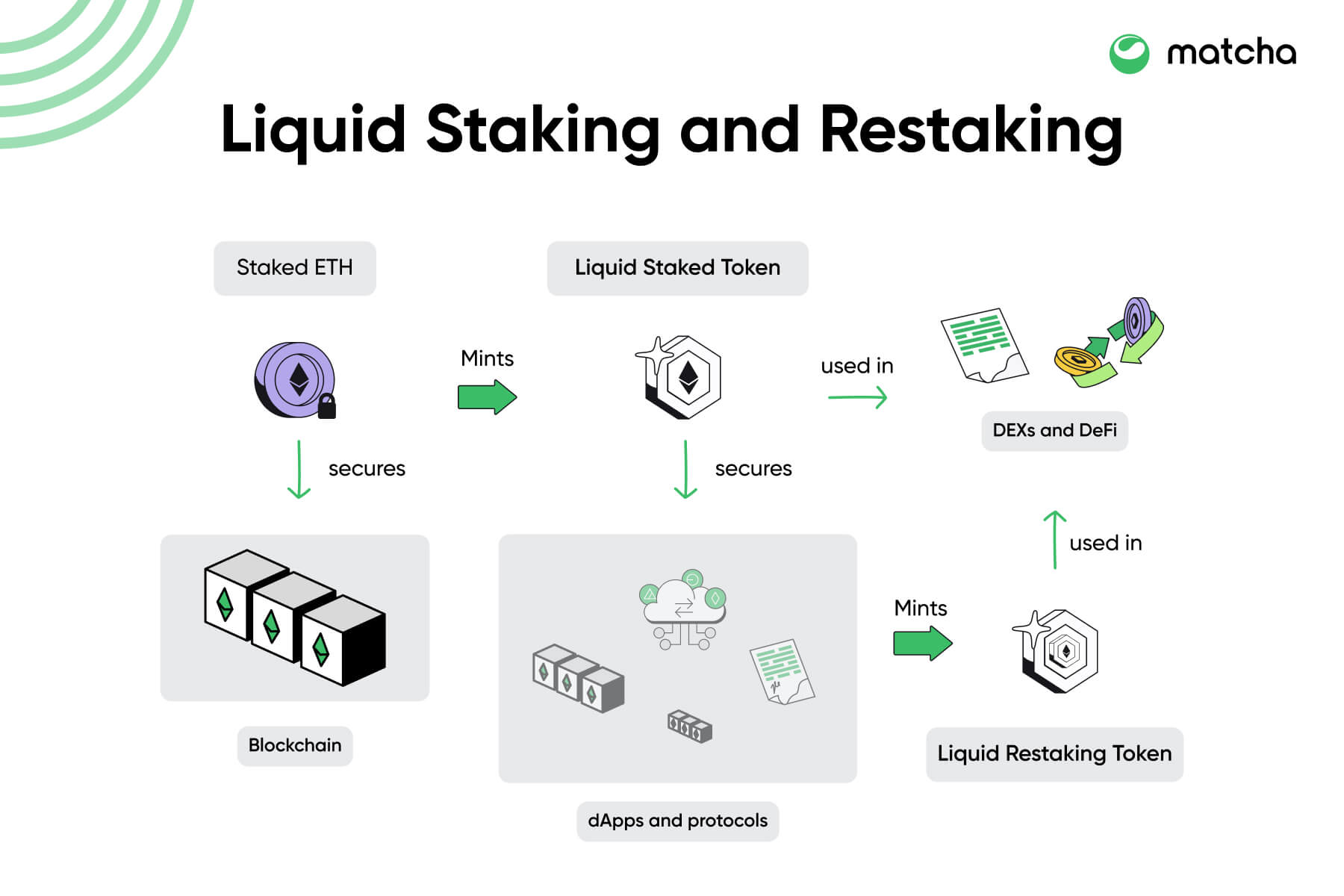
The technical distinction lies in the execution. Ethereum restaking is seamless within the EVM, but Bitcoin restaking requires complex cryptographic proofs and time-locked transactions. This adds layers of complexity and potential failure points. For instance, if the bridging protocol fails or the time-lock is compromised, the security guarantee collapses. Investors must scrutinize the specific implementation of these time-locks and the audit status of the bridging contracts, as the attack surface is significantly larger than in native Ethereum restaking.
Comparing yield and risk profiles
Restaking derivatives offer distinct yield sources and risk vectors. While some protocols prioritize capital efficiency through liquid tokens, others focus on maximizing yield through diversified restaking strategies. Evaluating these trade-offs requires a clear view of underlying assets, lock-up periods, and smart contract exposure.
The following table compares the primary characteristics of leading restaking derivatives in 2026. Data reflects current protocol documentation and on-chain metrics.
| Protocol | Underlying Asset | Yield Source | Liquidity Feature | Risk Profile |
|---|---|---|---|---|
| EigenLayer (eigenETH) | ETH | Restaking rewards, ETH staking | Fully liquid | Medium |
| Renzo (ezETH) | ETH | Restaking, active management | Fully liquid | Medium-High |
| Puffer (pufETH) | ETH | Restaking, insurance pool | Fully liquid | Medium |
| Karak (kETH) | ETH | Restaking, auto-compounding | Fully liquid | Medium-High |
| Babylon (BTC staking) | BTC | BTC restaking, L2 incentives | Semi-liquid (varies) | High |
Key Trade-offs
Yield vs. Security: Protocols like EigenLayer and Renzo distribute yield across multiple restaked assets, potentially increasing returns but also spreading risk across more smart contracts. Puffer introduces an insurance pool to mitigate slashing risks, which may slightly reduce net yield but offers a safety net.
Liquidity Needs: All major ETH-based restaking derivatives (eigenETH, ezETH, pufETH, kETH) are fully liquid, allowing users to trade or use them in other DeFi protocols. Babylon’s BTC restaking products often involve longer lock-up periods or semi-liquid structures, reflecting the different risk tolerance of BTC holders.
Smart Contract Risk: Each restaking layer adds complexity. EigenLayer’s modular design means users are exposed to the security of every Actively Validated Service (AVS) they restake into. Renzo and Karak use automated strategies, which can optimize yield but introduce additional smart contract risk from their strategy managers.
Note: Yield figures are dynamic and depend on network conditions, AVS demand, and protocol fees. Always verify current APYs on official protocol dashboards before committing capital.
For real-time price tracking of these underlying assets, refer to the live market data below.
Systemic risks and slashing events
Restaking amplifies yield potential, but it also concentrates risk across multiple layers of the ecosystem. In 2026, as Liquid Restaking Tokens (LRTs) and Bitcoin restaking protocols expand, the complexity of these derivative layers introduces new vulnerabilities. The primary concern is not just individual protocol failure, but the systemic correlation of risks that can cascade through the entire network.
Correlated slashing risk
Slashing events occur when a validator behaves maliciously or fails to perform its duties, resulting in the loss of staked assets. In traditional staking, this risk is isolated to a single validator set. However, in restaking, a single validator can secure multiple networks simultaneously. If that validator is slashed, the penalty applies to all the restaked assets it supports. This creates a correlated slashing risk where a single point of failure can impact multiple protocols and their users at once.
Smart contract vulnerabilities
The derivative layers introduced by LRTs and Bitcoin restaking protocols add additional smart contract surfaces. Each layer of abstraction increases the potential for bugs, exploits, or governance failures. Unlike native staking, where the security model is well-understood and battle-tested, restaking derivatives are relatively new and less audited. Investors must carefully evaluate the audit history and security track record of each protocol they interact with.
The importance of audits
As the restaking ecosystem matures, the importance of rigorous smart contract audits cannot be overstated. Protocols that undergo comprehensive audits by reputable firms provide a higher degree of confidence in their security. However, audits are not a guarantee against exploits; they are a necessary but insufficient condition for safety. Users should also consider the governance model of a protocol, as centralized governance can introduce additional risks if key holders act maliciously or negligently.
To understand the broader market context, it is helpful to look at the performance of underlying assets. The following chart shows the recent price action of Bitcoin, which is often the primary asset being restaked in Bitcoin-specific protocols.
Key questions on restaking safety
Restaking derivatives introduce complex risk vectors that differ from traditional staking. Understanding these mechanics is essential for capital preservation in 2026.
What happens if a restaking validator is slashed?
When a validator is slashed for misbehavior, the penalty typically applies to the underlying staked asset (ETH or BTC) and any restaked derivatives linked to it. Protocols like Babylon and EigenLayer enforce slashing conditions across the restaking layer. If the validator fails to meet its duties, the associated LRT (Liquid Restaking Token) value drops proportionally. This creates a "double jeopardy" scenario where investors lose yield and principal simultaneously. Always review the specific slashing policy of the protocol before depositing.
Is Bitcoin restaking safer than Ethereum restaking?
Bitcoin restaking, primarily driven by protocols like Babylon, offers a different risk profile than Ethereum restaking. BTC restaking generally involves fewer active execution layers, reducing exposure to smart contract bugs in complex LRT wrappers. However, it introduces custodial and bridge risks if the protocol relies on wrapped BTC. Ethereum restaking benefits from a more mature validator ecosystem but carries higher complexity due to the interaction between consensus and execution layers. There is no universal "safer" option; safety depends on your risk tolerance for smart contract risk versus bridge risk.
Can I withdraw my restaked assets at any time?
Liquidity varies significantly by protocol. Liquid Restaking Tokens (LRTs) like those from EigenLayer or Ether.fi allow secondary market trading, but you are subject to market liquidity and slippage. Direct restaking positions often have lock-up periods or withdrawal queues. Always check the protocol’s documentation for withdrawal timelines. In high-stress market conditions, these queues can extend, trapping capital when you need it most.
No comments yet. Be the first to share your thoughts!