
How Restaking Derivatives Work
Restaking derivatives allow Ethereum validators to reuse their already-staked ETH to secure additional protocols. Instead of locking capital for a single purpose, validators delegate their security to new networks while maintaining their base Ethereum stake. This mechanism creates a modular crypto environment where one unit of collateral supports multiple services simultaneously.
The process begins when a validator deposits ETH into a liquid restaking token (LRT) protocol. These protocols issue a derivative token representing the staked position. The underlying ETH continues to secure the Ethereum network, earning standard consensus rewards. Simultaneously, the protocol delegates this security to other networks, such as oracle providers, bridge validators, or decentralized compute networks.
By reusing the same collateral, validators can earn yield from multiple sources. The primary yield comes from Ethereum staking rewards, while secondary yield accrues from the services secured by the restaked ETH. This dual-income stream amplifies returns but also concentrates risk. If a delegated protocol fails or is slashed, the validator’s entire ETH position is vulnerable. Restaking derivatives thus function as a leverage mechanism for security, not just capital.
Leading LRT protocols compared
Liquid Restaking Tokens (LRTs) have matured from experimental yield hacks into distinct financial products with different risk profiles. In 2026, the market is no longer a monolith; it is segmented by how protocols layer yield sources and manage smart contract risk. Understanding the mechanical differences between these protocols is essential for allocating capital efficiently.
The core value proposition of an LRT is the ability to earn Ethereum staking rewards while maintaining liquidity. However, the additional yield comes from "restaking" those underlying assets to secure other networks or oracle services. This creates a multi-layered risk environment where a failure in a downstream protocol can impact the LRT's solvency. The table below compares the top protocols by their primary yield sources and market positioning.
| Protocol | Est. TVL | Primary Yield Source | Risk Profile |
|---|---|---|---|
| EigenLayer | $12.4B | Native restaking points & EIGEN | High (Smart contract & slashing) |
| Ether.fi (eETH) | $3.8B | Staking rewards + Restaking fees | Medium (Single vault) |
| Renzo (ezETH) | $1.9B | Restaking + Liquid staking derivatives | Medium (Multi-vault strategy) |
| Puffer (pufETH) | $1.2B | Staking + EigenLayer + Flashbots | Low-Medium (Insurance pool) |
| Kelp DAO (rsETH) | $0.9B | Restaking + Osmosis liquidity | Medium (DeFi integration) |
Each protocol manages this risk differently. EigenLayer acts as the foundational settlement layer, offering the highest potential yield but exposing users to the broadest range of smart contract vulnerabilities. Newer entrants like Ether.fi and Renzo attempt to mitigate this by wrapping the restaking position in their own vaults, adding a layer of abstraction that can simplify user experience but introduces additional smart contract complexity.
Liquid restaking is not a single asset class; it is a spectrum of yield extraction and risk assumption.— Matcha Research
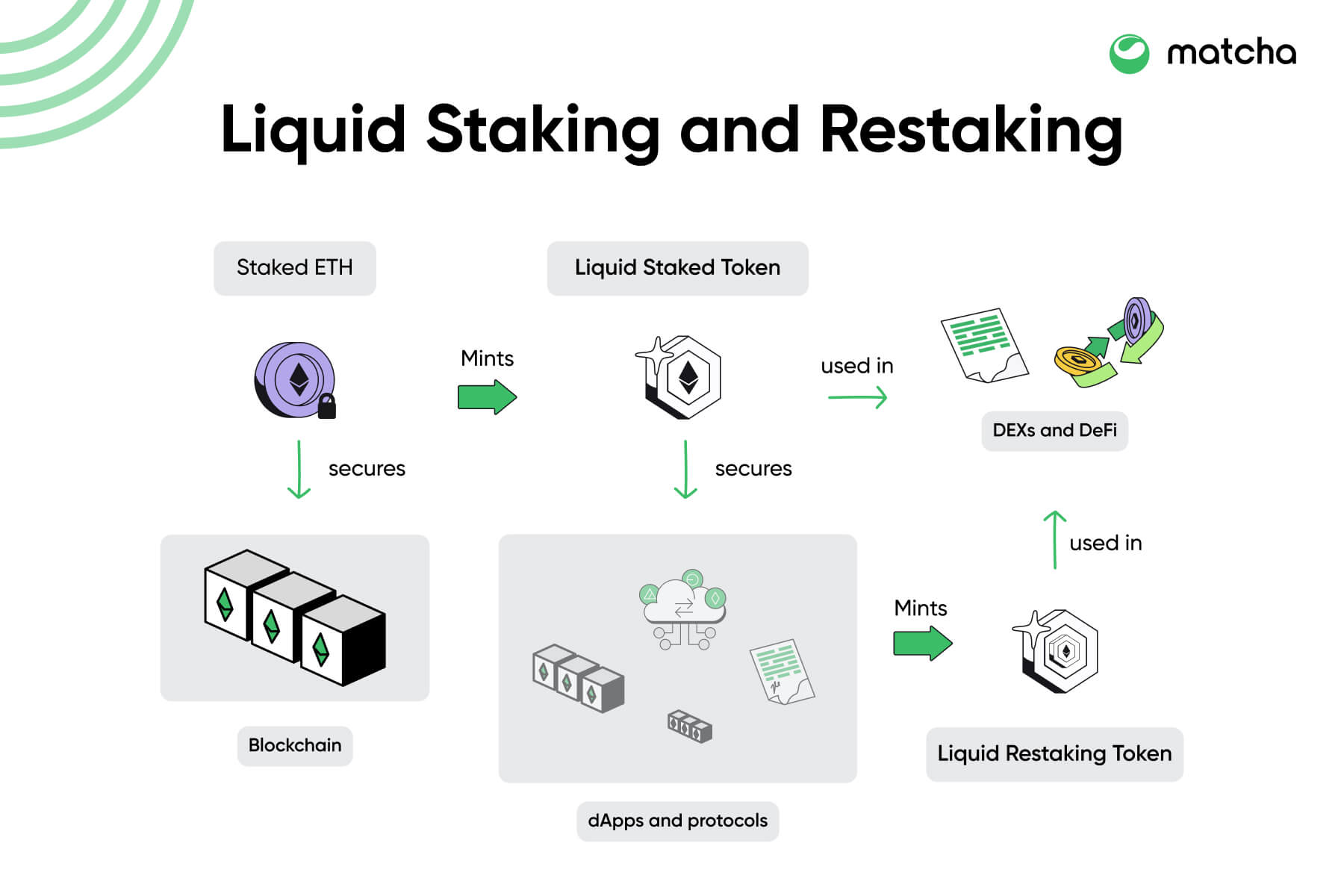
The diagram below illustrates the structural difference between standard liquid staking and the more complex restaking derivatives that dominate the 2026 landscape. Notice how the LRT sits atop the LST, creating a new layer of financial engineering that requires careful auditing.
Live LRT and ETH pricing
The following widgets provide real-time pricing for Ethereum and the major LRT tokens discussed above. Note that LRT prices often trade at a slight premium or discount to their underlying ETH value depending on market demand for liquidity and perceived risk.
Risk Disclosure: Restaking involves significant smart contract risk. A bug in the underlying protocol or a slashing event on a consumer network can result in total loss of capital. Always verify the specific slashing conditions and insurance mechanisms of each protocol before investing.
Where Yield Comes From
Restaking derivatives like Liquid Restaking Tokens (LRTs) generate yield by stacking multiple revenue streams on top of base Ethereum staking. The foundation is the ~3-4% annual percentage yield (APY) from securing the Ethereum network itself. When you restake, you delegate that same staked ETH to additional protocols known as Actively Validated Services (AVS). These services—ranging from oracle networks to decentralized sequencers—pay extra rewards for the security provided. This creates a composite yield that is theoretically higher than solo staking, but it is also more complex and fragile.
The mechanical advantage of LRTs is capital efficiency. Instead of locking ETH in one protocol, the same collateral secures multiple layers of the crypto economy. However, this efficiency introduces a specific type of risk: overlapping exposure. If one AVS fails or is compromised, the underlying staked ETH is still at risk of slashing. You are not just betting on Ethereum’s consensus; you are betting on the operational security of every AVS you support.
The Risk of Slashing
Slashing is the primary penalty mechanism in proof-of-stake systems. It involves the forced destruction of a validator’s stake for malicious behavior or severe downtime. In a standard staking setup, slashing affects only the validator operator. In restaking, the risk is amplified. Because your ETH is securing multiple AVSs, a misbehavior in any one of them can trigger a slash. This means your entire restaked position is exposed to the weakest link in the security chain.
Smart contract risk is the second major layer. LRT protocols involve complex code that manages the delegation, reward distribution, and liquidation of assets. A bug in the LRT contract or the underlying AVS contract can lead to total loss of funds. Unlike traditional finance, there is no insurance fund or regulatory backstop. The code is the law, and if the code fails, the yield disappears along with the principal.
Managing Exposure
Understanding the source of yield is critical for managing risk. The extra yield from AVSs is not free money; it is a premium for taking on additional operational and smart contract risk. Investors should view restaking not as a passive income stream, but as a active security service provider role. The higher the yield, the more likely it is that the underlying protocols are newer, less battle-tested, or have higher operational demands.
Diversification across AVSs can mitigate some slashing risk, but it does not eliminate smart contract risk. The complexity of the stack means that a vulnerability in one layer can cascade through the entire system. Always verify the audit status of the LRT protocol and the AVSs it supports. The mechanical explanation of LRTs reveals that yield is a function of risk density, not just market demand.
How to pick an LRT strategy
Selecting a Liquid Restaking Token (LRT) strategy requires aligning your risk tolerance with your yield objectives. LRTs allow you to stake ETH while retaining liquidity, but they introduce complex layers of smart contract risk and slashing exposure. Your choice should depend on whether you prioritize capital preservation or maximum yield efficiency.
Conservative: Base Protocol Yield
For investors seeking lower risk, base LRT strategies focus on the underlying security of the staked asset. These protocols typically offer lower yields but provide a more direct link to Ethereum’s consensus rewards. The primary advantage is reduced complexity; you are exposed primarily to Ethereum’s staking mechanics rather than additional restaking layers. This approach suits those who want to participate in restaking without taking on significant counterparty risk from third-party restaking operators.
Aggressive: Leveraged Yield Farming
Aggressive strategies involve restaking LRTs into other DeFi protocols to leverage yield. This can significantly boost returns but multiplies the risk. If the underlying LRT protocol is exploited or if slashing occurs, your leverage amplifies the loss. This path is suitable only for experienced participants who understand the mechanical failure points of both the staking and the lending/borrowing layers. Always verify the audit status and insurance coverage of any protocol you interact with.
Balanced: Diversified Operator Sets
A balanced approach involves distributing stakes across multiple restaking operators and protocols. This diversification mitigates the impact of a single point of failure. While yields may be slightly lower than concentrated aggressive strategies, the risk-adjusted return is often superior. Look for LRTs that automatically rebalance operator exposure or offer governance controls to shift risk dynamically. This strategy is ideal for long-term holders who want steady yield without monitoring every protocol update.
Key Takeaways
- Base LRTs offer lower risk and direct Ethereum yield.
- Aggressive strategies use leverage for higher returns but higher risk.
- Diversified operator sets balance yield and security effectively.
- Always audit smart contract risks and slashing conditions before investing.
Frequently asked: what to check next
What will 1 ETH be worth in 2026?
Price forecasts vary widely, with some analysts projecting ETH could break $5,000 if macroeconomic conditions and network adoption align. However, these predictions remain speculative. Restaking yields are mechanical, not guaranteed; they depend on network security fees and liquid restaking token (LRT) demand, which fluctuate with market cycles.
Is Ethereum going to break $5,000?
Historical resistance levels suggest $5,000 is a plausible target for 2026, provided institutional inflows and staking participation remain strong. This breakout is not automatic. It requires sustained network utility and favorable regulatory clarity. Relying on price appreciation alone ignores the mechanical risks of restaking protocols, which can suffer from slashing events or smart contract vulnerabilities.
Is restaking safe for long-term holding?
Restaking amplifies yield but also amplifies risk. By re-staking ETH to secure multiple networks, you expose your capital to shared security failures. If one network fails, your entire stake may be slashed. Long-term viability depends on robust protocol audits and diversified risk management, not just yield chasing. Treat LRTs as high-risk instruments, not passive savings accounts.
No comments yet. Be the first to share your thoughts!