
The 2026 restaking market landscape
The restaking economy has matured from an experimental niche into a foundational layer of modular security. By 2026, the market is projected to expand from $21.8 billion to $198.7 billion by 2034, reflecting a compound annual growth rate of 31.2% Intel Market Research. This trajectory signals that restaking derivatives are no longer just yield-enhancing tools but critical infrastructure for decentralized consensus.
This growth is driven by the shift toward shared security models. Protocols like EigenLayer and Babylon are enabling validators to reuse their staked assets across multiple networks, creating a dense web of economic security. For institutional participants, this means access to diversified yield streams without the capital inefficiency of separate staking positions.
The rise of restaking derivatives also introduces complex risk vectors. While yield potential increases, so does the attack surface for slashing events. As the market scales, the correlation between different restaking protocols becomes a key metric for risk management. Investors must navigate this landscape with a focus on protocol-specific safeguards and liquidity depth.
Ethereum vs Bitcoin restaking mechanics
Restaking derivatives 2026 strategies diverge sharply based on the underlying asset's consensus layer. Ethereum restaking, pioneered by EigenLayer, leverages the existing proof-of-stake validator set to secure additional protocols. This approach reuses the same cryptographic security, creating a modular ecosystem where validators provide slashing protection to multiple services simultaneously. Bitcoin restaking, primarily driven by Babylon and Solv, operates on a fundamentally different premise: leveraging Bitcoin's hash rate or UTXO-based collateral without requiring Bitcoin validators to run new software.
The technical distinction lies in how security is anchored. In the Ethereum model, restaking derivatives are deeply integrated with the execution layer. When a validator restakes ETH, they are effectively cosigning the security of new protocols, such as oracles or bridge networks. This creates a dense web of interdependencies where a failure in one restaked service can trigger cascading slashing events across the broader ecosystem. The yield generated is often a combination of base staking rewards and additional protocol incentives, creating a complex yield curve that requires constant monitoring.
Bitcoin restaking introduces a different risk profile. Protocols like Babylon allow Bitcoin holders to stake their BTC to secure other proof-of-stake chains, while Solv focuses on tokenizing BTC to generate yield through DeFi strategies. Unlike Ethereum, Bitcoin does not have a native validator set that can be easily repurposed for smart contracts. Instead, these mechanisms rely on time-locked UTXOs or wrapped representations of BTC. This separation provides a layer of isolation; if a restaked protocol fails, the underlying Bitcoin collateral is typically locked rather than slashed in the same manner as ETH validators. However, this comes with the added counterparty risk of the wrapping or locking mechanism itself.
| Feature | Ethereum Restaking (EigenLayer) | Bitcoin Restaking (Babylon/Solv) |
|---|---|---|
| Security Model | Reuses existing validator set and slashing conditions | Time-locked UTXOs or wrapped BTC collateral |
| Yield Source | Base staking + protocol incentives | DeFi yield, lending, or cross-chain security fees |
| Liquidity | Liquid restaking tokens (LRTs) available | Often locked or wrapped with varying liquidity |
| Risk Type | Cascading slashing across protocols | Counterparty and wrapping protocol risk |
The choice between these two models depends on your tolerance for systemic risk. Ethereum restaking offers higher potential yields but exposes capital to the health of the entire modular crypto ecosystem. Bitcoin restaking provides a more isolated risk profile but introduces complexities around custody and wrapping. For investors focused on restaking derivatives 2026, understanding these mechanical differences is essential for proper portfolio allocation.
Leading liquid restaking protocols
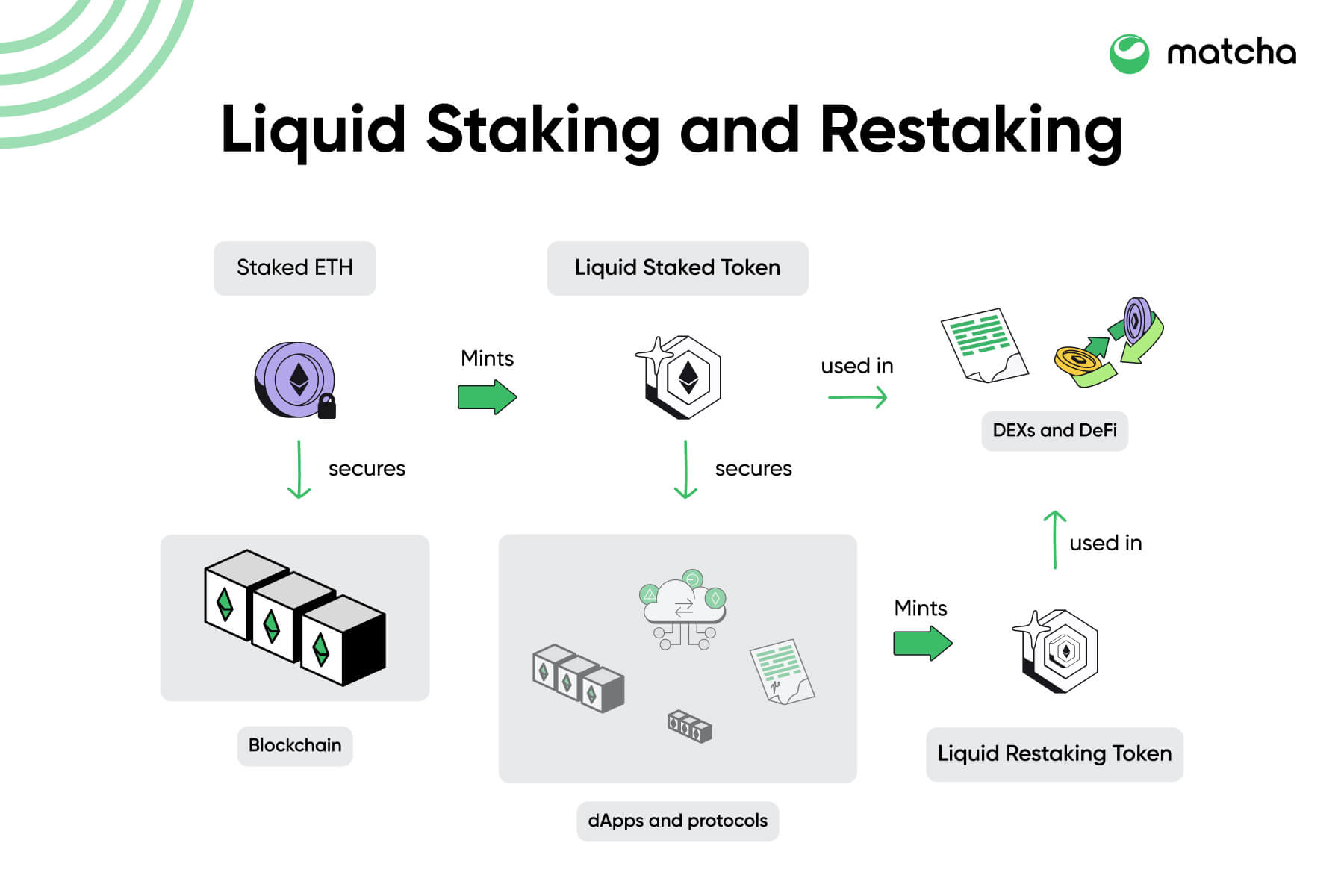
The liquid restaking token (LRT) sector has consolidated around a few dominant architectures. These protocols allow stakers to retain liquidity while providing restaked security to Actively Validated Services (AVS). The yield profile is a composite of base staking rewards, restaking fees, and protocol-specific incentives.
EigenLayer: The foundational layer
EigenLayer pioneered the restaking model on Ethereum. It acts as a shared security layer, allowing ETH stakers to "restake" their assets to secure other protocols without slashing penalties for the underlying ETH. Yields come from the 4-5% base ETH staking rate plus variable fees from AVS contracts. The protocol uses EigenPod (self-custodial) and liquid restaking tokens (LRTs) like ether.fi or Renzo to provide liquidity.
Babylon: Bitcoin restaking
Babylon introduces restaking to Bitcoin by using time-locked staking and checkpointing. Unlike Ethereum, Bitcoin lacks native smart contract complexity for slashing, so Babylon relies on economic finality and lock-up periods. Yields are driven by the demand for Bitcoin-backed security from AVSs. This creates a distinct yield curve compared to Ethereum LRTs, often offering higher incentives to attract BTC liquidity.
Solv Protocol: Yield aggregation
Solv Protocol focuses on optimizing yields across multiple restaking layers. It aggregates LRTs and restakes them again, creating a recursive yield structure. This approach aims to maximize APY by capturing incentives from multiple AVSs simultaneously. However, the complexity introduces additional smart contract risk and potential centralization points in the yield distribution mechanism.
Yield composition breakdown
Understanding the source of yield is critical for risk assessment. Base staking rewards are the most stable component, derived from consensus layer issuance. Restaking fees are variable and depend on AVS demand. Incentive tokens (governance tokens) are the most volatile, often diluting the effective APY over time. Investors should distinguish between sustainable yield and token emission-driven returns.
Slashing risks and smart contract exposure
Restaking derivatives amplify yield by pooling validator capital, but they also concentrate risk. When an Ethereum validator signs conflicting blocks or goes offline, the slashing penalty applies to the entire stake. In a restaking context, that single penalty can drain the collateral backing multiple Liquid Restaking Tokens (LRTs) simultaneously, creating a cascading failure mode for protocols relying on that shared security.
Smart contract vulnerabilities present an equally acute threat. LRT contracts manage complex logic for yield distribution, withdrawal queues, and risk parameter updates. A single exploit in the underlying vault or the restaking layer can freeze user assets or drain liquidity. Unlike traditional staking, where the validator node is the primary attack surface, restaking derivatives introduce a multi-layered codebase that requires rigorous auditing across every protocol in the stack.
Systemic correlation further tightens this risk loop. As more protocols restake the same underlying ETH, the network becomes increasingly correlated. A bug in a major restaking protocol or a coordinated attack on a specific validator set can impact yield across the entire sector, not just the affected service. Investors must treat restaking not as a passive income stream, but as a high-stakes exposure to both cryptographic and code-level failure.
Technical outlook for ETH and LRTs
Ethereum’s price action remains the primary anchor for restaking derivatives 2026. Liquid Restaking Tokens (LRTs) exhibit a high beta to ETH, meaning their performance is inextricably linked to the underlying asset’s volatility. When ETH consolidates or trends upward, LRT yields often appear more attractive due to the stability of the base layer. Conversely, sharp drawdowns in ETH can trigger liquidation cascades across restaking protocols, amplifying losses beyond simple staking penalties.
The correlation between ETH price stability and restaking protocol health is critical for risk assessment. As the market cap of restaking platforms expands, the systemic risk increases. A sustained ETH rally supports the capitalization requirements of EigenLayer and Babylon, reducing the likelihood of slashing events. However, if ETH enters a prolonged bearish phase, the yield generated by restaking may fail to offset the opportunity cost of locked capital.
Technical indicators suggest that ETH is currently testing key support levels. A break below these zones could signal increased volatility for restaking derivatives. Traders should monitor the Relative Strength Index (RSI) and trading volume to gauge momentum. If ETH fails to reclaim resistance, restaking yields may become less competitive compared to traditional fixed-income assets or simple staking.
The broader market outlook for restaking derivatives 2026 depends on Ethereum’s ability to maintain liquidity. While the sector is projected to grow significantly, as noted by Intel Market Research, this growth assumes a stable or appreciating ETH price. Investors must weigh the potential for high yields against the technical risks of the underlying asset. Without ETH price appreciation, the total return on restaking positions may underperform simpler staking strategies.
Frequently asked questions on restaking
Could Ethereum hit $10,000?
Market models suggest a potential surge to $10,000 driven by institutional accumulation and liquidity patterns. While technical indicators point to building demand, this price action remains speculative. For restaking derivatives, a higher ETH baseline increases the absolute yield potential of liquid staking tokens, but it also raises the cost of entry for new capital. The viability of restaking strategies depends less on reaching a specific price target and more on the protocol's ability to maintain security premiums during volatility.
What will 1 ETH be worth in 2026?
Predictions for 1 ETH vary widely, ranging from conservative estimates near current levels to bullish scenarios exceeding $8,000. These forecasts rely on macroeconomic conditions and Ethereum network upgrades rather than fixed fundamentals. In the context of restaking derivatives 2026, the exact price of ETH is secondary to the stability of the underlying yield. Protocols like EigenLayer and Babylon focus on securing additional assets regardless of ETH's market valuation, making the protocol's risk profile more critical than the asset's price trajectory.
How does ETH price affect restaking yields?
Restaking yields are composed of base staking rewards and additional security premiums. When ETH price rises, the dollar-denominated value of these rewards increases, attracting more capital. However, higher prices often correlate with increased network congestion and potential security risks, which can impact the reliability of restaking returns. Investors should monitor the ratio between base yield and security premium to gauge whether the restaking derivative is offering genuine alpha or merely reflecting market beta.
No comments yet. Be the first to share your thoughts!