
How restaking derivatives work in 2026
Use this section to make the Restaking Derivatives decision easier to compare in real life, not just on paper. Start with the reader's actual constraint, then separate must-have requirements from details that are merely nice to have. A practical choice should survive normal use, maintenance, timing, and budget. If a recommendation only works in an ideal situation, call that out plainly and give the reader a fallback path.
The simplest way to use this section is to write down the must-have criteria first, then compare each option against those criteria before weighing nice-to-have features.
Ethereum restaking risks and shared security
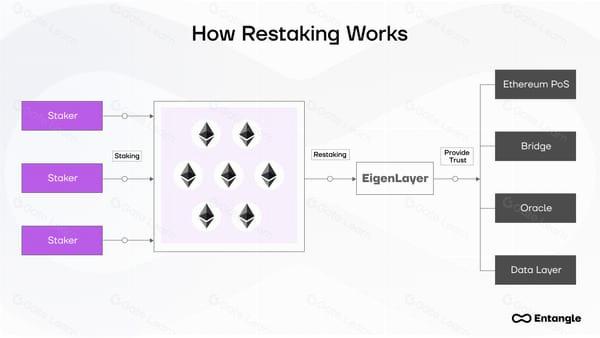
Restaking introduces a distinct layer of complexity to Ethereum staking by allowing validators to secure multiple protocols simultaneously. While this creates a "security premium" that boosts yields beyond the standard 2.8% to 3.2% base rate, it also concentrates risk across the entire ecosystem. Unlike native staking, where a validator secures only the Ethereum mainnet, restaking extends liability to Actively Validated Services (AVSs). This means a single misbehavior can trigger penalties across multiple layers, amplifying potential losses.
The primary technical risk is slashing. If a restaked validator is found to have acted maliciously or negligently in any secured protocol, the underlying Ethereum staking deposit can be slashed. This penalty is not isolated to the specific AVS; it impacts the core ETH stake itself. Because restaking protocols often require overlapping security, a failure in one niche protocol can cascade, jeopardizing the validator's entire position on Ethereum. This correlation creates a systemic risk that does not exist in traditional, single-purpose staking.
The tradeoff is clear: higher yields come with the potential for total stake loss. Investors must carefully evaluate the security model of each AVS and the slashing conditions of the restaking protocol. Understanding these mechanics is essential before allocating capital to restaking derivatives, as the risk profile is significantly more complex than standard ETH staking.
Bitcoin restaking protocols and yield models
Bitcoin restaking protocols unlock yield by securing other networks with BTC-based security, allowing holders to earn rewards without moving assets off-chain. Unlike Ethereum restaking, which relies on liquid staking derivatives (LSDs), Bitcoin restaking often utilizes native BTC or wrapped variants secured by a dedicated validator set.
The three dominant protocols—Babylon, Solv, and BounceBit—offer distinct approaches to this model. Babylon focuses on direct, unbonded security for Proof-of-Stake chains. Solv leverages BTC liquidity through its SolvBTC vaults to support DeFi applications. BounceBit operates as a comprehensive Bitcoin Bank, integrating restaking with native yield-bearing products.
| Protocol | Security Model | Primary Yield Source | Risk Profile |
|---|---|---|---|
| Babylon | Unbonded native BTC | PoS chain fees & incentives | High (smart contract + slashing) |
| Solv | SolvBTC vaults | DeFi lending & liquidity pools | Medium-High (vault smart contract) |
| BounceBit | BBTC (Wrapped BTC) | Native staking & DeFi strategies | Medium (centralized custody elements) |
Babylon’s unbonded model allows users to keep their BTC in their own wallets while delegating security to other chains. This reduces counterparty risk but exposes users to smart contract vulnerabilities in the delegating protocols. Solv and BounceBit require wrapping BTC, introducing custodial or smart contract risk in exchange for potentially higher, diversified yield streams from DeFi integrations.
Liquid staking token yield trends and adoption
The liquid staking token (LST) market has matured from a niche DeFi experiment into a foundational layer of Ethereum’s infrastructure. As of 2026, the global liquid staking market is projected to reach significant scale, with valuations expanding from $198 million in 2025 to an estimated $572 million by 2026, according to Intel Market Research. This growth reflects not just capital inflow, but the institutional acceptance of LSTs as reliable yield-bearing assets.
Yield differentials between major LSTs and restaking derivatives remain the primary driver of capital allocation. While traditional LSTs like stETH and rETH offer stable, baseline yields derived from Ethereum consensus rewards, restaking protocols layer additional yield by securing other networks. This creates a tiered yield environment where risk-adjusted returns vary significantly. Investors must weigh the simplicity of native staking against the enhanced yields of restaking, which introduce smart contract and slashing risks.
Choosing the right restaking strategy for 2026
Selecting a restaking approach requires aligning your portfolio’s liquidity needs with your tolerance for smart contract and slashing risk. In 2026, the market has segmented into three distinct tiers: liquid restaking tokens (LRTs) for flexibility, native restaking for maximum yield, and hybrid vaults for balanced exposure. Your decision should hinge on whether you prioritize capital efficiency or protocol security.
Liquid Restaking Tokens (LRTs)
LRTs represent the most accessible entry point for institutional and retail participants who require ongoing liquidity. By converting staked ETH into a tradeable derivative, you retain the ability to adjust positions without unbonding periods. This flexibility comes at a slight yield discount compared to native restaking, but it significantly reduces opportunity cost. LRTs are ideal for treasuries and active traders who view restaking as a component of a broader, dynamic strategy rather than a long-term hold. The primary risk remains the smart contract complexity of the LRT issuer, not just the underlying restaking protocol.
Native Restaking and EigenLayer
For investors seeking to maximize yield, native restaking through protocols like EigenLayer offers the highest potential returns. By directly delegating stake to Active Validation Services (AVSs), you capture the full value of the restaking premium without intermediary fees. However, this approach demands active management and a deep understanding of slashing conditions. If an AVS you are secured for misbehaves, your stake is penalized. This strategy suits sophisticated holders who can monitor protocol health closely and are willing to lock capital for extended periods to avoid unbonding penalties.
Hybrid Vaults and Diversification
Hybrid vaults attempt to bridge the gap by offering LRT-like liquidity with a portion of the capital exposed to native restaking yields. These structures often employ risk management layers, such as insurance pools or diversified AVS exposure, to mitigate slashing events. While they provide a middle ground, they introduce additional layers of smart contract risk from the vault operator. Investors should scrutinize the vault’s historical performance during market stress and verify that the underlying AVSs have robust economic security. Diversifying across multiple vaults can further dilute protocol-specific risks, ensuring that a single failure does not compromise the entire position.
common questions about restaking derivatives
The shift from Proof of Work to Proof of Stake has fundamentally altered how Ethereum validators secure the network, creating new yield opportunities through restaking derivatives.
Can you still mine Ethereum in 2026?
No. Ethereum mining ended permanently on September 15, 2022, with The Merge transition to Proof of Stake. The network no longer supports GPU or ASIC mining for ETH. All new yield generation occurs through staking and restaking protocols rather than computational hashing power.
Can Ethereum reach $100,000 in 2026?
A $100,000 ETH price target remains extremely improbable without a structural shift in global finance. For this milestone to materialize, governments, corporations, and markets would need to integrate Ethereum's rails as standard infrastructure. Current market dynamics suggest this scenario is a long-term outlier rather than a near-term baseline.
Is Ethereum going to break $5,000?
Ethereum has faced resistance at the $5,000 level in previous cycles, but 2026 is considered one of the more plausible years for this threshold to break, assuming favorable macroeconomic factors align. Restaking derivatives contribute to this potential by increasing capital efficiency and reducing the opportunity cost of holding ETH.
Helpful gear
Use these product recommendations as a starting point, then choose the size, material, and price point that fit how you actually use the gear.



As an Amazon Associate, we may earn from qualifying purchases.
No comments yet. Be the first to share your thoughts!