
Get restaking derivatives 2026 right
Start to Restaking Derivatives with the constraint that matters most in real life: space, timing, budget, skill level, maintenance, or availability. That first constraint should shape the rest of the plan instead of appearing as an afterthought. Keep the first pass simple enough to verify. Compare the main options against the same criteria, remove choices that only work in ideal conditions, and save optional upgrades for later.
The simplest way to use this section is to write down the real constraint first, compare each option against it, and choose the path that still works outside ideal conditions.
Work through the steps
Restaking derivatives let you layer yield on top of staked ETH, but the mechanics require careful execution to avoid slashing or smart contract risks. The process involves bridging your liquid staking tokens (LSTs) into protocols like EigenLayer or EtherFi, where they act as active validation assets. Because you are entrusting your capital to new smart contract layers, following a strict sequence is necessary to secure your position and maximize the security premium.
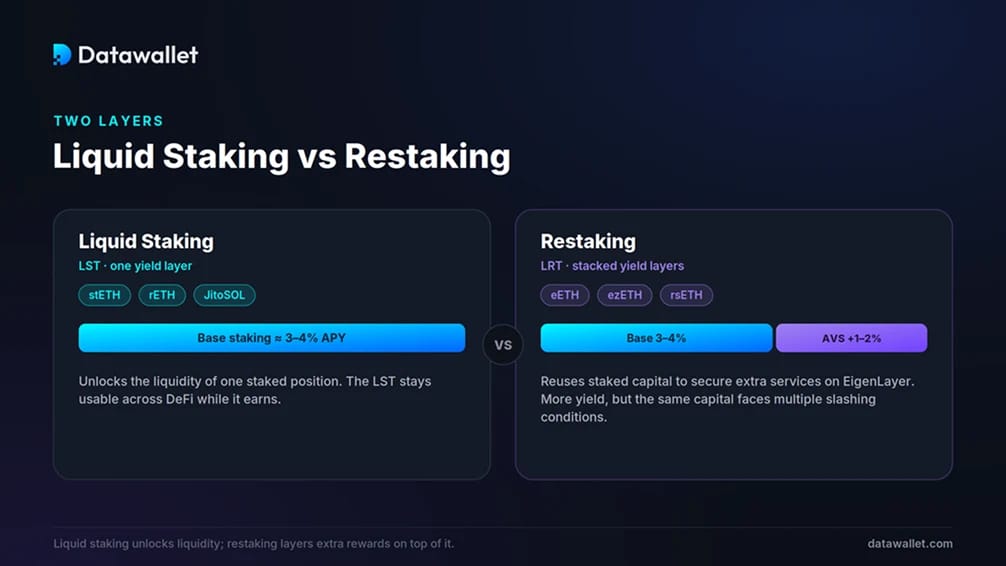
Before interacting with any restaking protocol, ensure your liquid staking tokens (like stETH or wstETH) are in a non-custodial wallet you control. Never restake tokens held on an exchange unless the platform explicitly supports native restaking integration. This gives you the flexibility to manage your positions and provides a clear audit trail for your on-chain activity.
Review the Total Value Locked (TVL) and historical performance of the restaking layer. As of early 2026, the restaking category holds approximately $11.5 billion in TVL, with EigenLayer and EtherFi dominating the landscape. Check the specific "slashing conditions" for each protocol—these are the smart contract rules that define when your stake could be penalized. Higher yields often correlate with more complex slashing conditions, so prioritize protocols with transparent, well-audited security parameters.
Connect your wallet to the official dApp interface. You will need to approve the restaking contract to spend your LSTs. Once approved, deposit the tokens into the protocol’s vault. This action mints a restaking derivative token (such as eETH or rETH) that represents your position. Verify the transaction on a block explorer to ensure the derivative tokens were minted to your address before proceeding.
Restaking is not passive; you must choose which Actively Validated Services (AVSs) your capital secures. Allocate your derivative tokens to specific AVSs based on your risk tolerance. Some AVSs offer higher yields but carry higher slashing risks. Diversify your allocation across multiple AVSs if the protocol allows, rather than concentrating all your stake in a single, high-yield service.
Regularly check the health of your restaking positions. Monitor the yield distribution and any changes to the slashing conditions of the AVSs you support. If an AVS experiences a security incident or if yield opportunities shift significantly, consider withdrawing and reallocating your capital. Set up alerts for your wallet address to stay informed of any on-chain activity related to your restaked assets.
-
Verify LST balance in non-custodial wallet
-
Review slashing conditions for chosen AVSs
-
Confirm derivative token minting on block explorer
-
Diversify allocation across multiple services
-
Set up wallet alerts for position changes
No comments yet. Be the first to share your thoughts!