
Choose your liquid restaking token
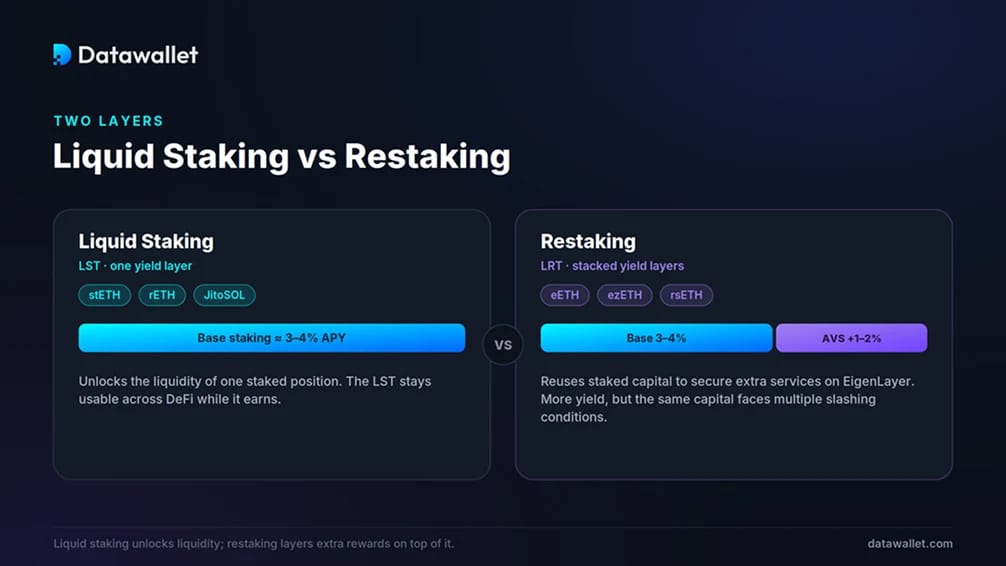
Selecting the right liquid restaking token (LRT) determines your risk profile and potential yield. The foundation of restaking is Ethereum's base staking yield, which sits around 2.8–3.2% as of early 2026. LRTs add value by restaking this ETH into Actively Validated Services (AVS), earning a "security premium" on top of the base reward [[src-serp-3]].
Your choice depends on whether you prioritize protocol stability or higher yield. Established tokens like rETH offer lower but more predictable returns through well-audited infrastructure. Newer or more aggressive LRTs may offer higher APYs but carry greater smart contract and slashing risks. You are essentially trading volatility for extra yield.
To compare the current market leaders, review the key metrics below. This comparison highlights the trade-offs between Total Value Locked (TVL), which indicates liquidity and trust, and the yield APY, which reflects the risk premium.
| Protocol | TVL (Est.) | Yield APY | Risk Profile |
|---|---|---|---|
| Ether.fi (eETH/ethr) | High | Base + AVS Premium | Moderate |
| Renzo (ezETH) | High | Base + AVS Premium | Moderate |
| Kelp DAO (rsETH) | Medium-High | Base + AVS Premium | Moderate |
| Puffer (pufETH) | Medium | Base + AVS Premium | Moderate-High |
The table above shows that top protocols like Ether.fi, Renzo, and Kelp offer similar structural yields derived from the same underlying Ethereum staking base [[src-serp-1]]. The difference lies in their specific AVS partnerships and insurance mechanisms. For instance, Puffer offers insurance against slashing, which can mitigate the "Moderate-High" risk rating despite potentially higher volatility. Always verify the current APY, as it fluctuates with AVS demand and Ethereum's base rate.
Bridge ETH to the restaking layer
To participate in restaking, you must move your ETH from a standard wallet or exchange to the specific protocol interface, either EigenLayer or Ether.fi. This process converts your native ETH into a liquid restaking token (LRT) or a restaked position, allowing it to secure additional networks while earning yield.
Navigate to the official EigenLayer or Ether.fi website. Connect your Web3 wallet, such as MetaMask or Rabby, to the platform. Ensure you are on the correct Ethereum mainnet to avoid sending funds to the wrong chain.
If your ETH is in a centralized exchange like Coinbase or Binance, you must first withdraw it to your personal wallet. Once in your wallet, deposit the ETH into the protocol’s smart contract. EigenLayer accepts native ETH directly, while Ether.fi typically requires you to swap for their eETH token first.
Review the transaction details and gas fees. After confirmation, your position will appear in your dashboard. You will receive a derivative token (such as slisETH or eETH) that represents your restaked position, which you can hold or use in other DeFi applications.
Monitor slashing and correlation risks
Restaking multiplies yield by exposing your staked ETH to multiple protocols, but it also multiplies the downside. If an active validator you’ve delegated to misbehaves, the penalty doesn’t just affect that single service; it can trigger a "slashing" event that burns a portion of your principal across all protocols using that validator’s keys. This is the primary danger of restaking derivatives like those on EigenLayer or Ether.fi.
Slashing is not a bug; it’s a consensus mechanism designed to penalize malicious or incompetent validators. When a validator is slashed, the protocol typically liquidates a portion of the staked ETH to compensate for the harm done to the network. In a restaking setup, this liquidation can cascade. If multiple Actively Validated Services (AVSs) rely on the same validator set, a single failure can drain value from multiple positions simultaneously.
Warning: Slashing risks are real and can result in permanent loss of principal. Always check the audit reports of the AVSs you delegate to and understand the specific slashing conditions outlined in the protocol documentation.
Correlated liquidation adds another layer of complexity. Because most restaking derivatives are backed by the same underlying ETH, a sharp drop in Ethereum’s price can trigger liquidations across the entire sector at once. This correlation means your portfolio lacks the diversification benefits you might expect from holding different tokens. When the market turns, restaking positions often fall in lockstep, amplifying losses.
To manage these risks, you must actively monitor the health of the validators you support. Use dashboard tools provided by EigenLayer and Ether.fi to track validator uptime and performance. If a validator shows signs of instability or repeated infractions, consider reallocating your stake to a more reliable operator. Ignoring these signals is akin to holding a stock without watching its earnings reports—you’re gambling, not investing.
The key is to treat restaking as a high-stakes active position rather than a passive savings account. Regularly review your delegation choices and stay informed about any changes to the slashing conditions or liquidation thresholds in the protocols you use.
Rebalance your restaking portfolio
Restaking is not a set-and-forget strategy. To maintain healthy yields while managing slashing risks, you need to monitor your positions regularly. This involves harvesting rewards, adjusting exposure to different protocols like EigenLayer and ether.fi, and ensuring your liquid staking tokens (LSTs) remain aligned with market conditions.
Log into your restaking dashboard at least once a month to claim accumulated rewards. You can either withdraw these rewards to a secure wallet or re-stake them to compound your returns. Compounding is particularly effective in high-yield environments, but ensure you account for any gas fees associated with the transaction to avoid eating into your profits.
Review the performance of each restaking layer. Check if the underlying validators are operating efficiently and if the protocol’s points or rewards distribution has changed. If a specific protocol shows signs of instability or reduced yields, consider shifting a portion of your capital to a more reliable option. This step is crucial for maintaining the integrity of your restaking derivatives portfolio.
If the crypto market is volatile, consider reducing your exposure to high-risk restaking layers. You can do this by unstaking from aggressive protocols and moving funds into more conservative LSTs or stablecoins. Conversely, in bull markets, you might increase exposure to capture higher yields. Always keep a portion of your portfolio in liquid assets to take advantage of market opportunities.
Periodically review the overall allocation of your portfolio. If one asset, such as ETH or a specific LST, has grown significantly, it may now represent a larger percentage of your portfolio than intended. Rebalance by selling a portion of the over-weighted asset and buying under-weighted assets to maintain your desired risk profile.
Checklist for monthly review:
-
Claim and re-stake or withdraw rewards
-
Check validator status and protocol health
-
Assess market conditions and adjust exposure
-
Rebalance asset allocation to target percentages
Restaking derivatives 2026 FAQ
This section addresses common questions about the mechanics and viability of restaking in the current market cycle. The answers rely on official source data and current network parameters.
These answers clarify that restaking is a derivative of the existing proof-of-stake model, not a separate consensus layer. The yield comes from the additional security services provided to other protocols, not from inflationary token emissions.
No comments yet. Be the first to share your thoughts!