
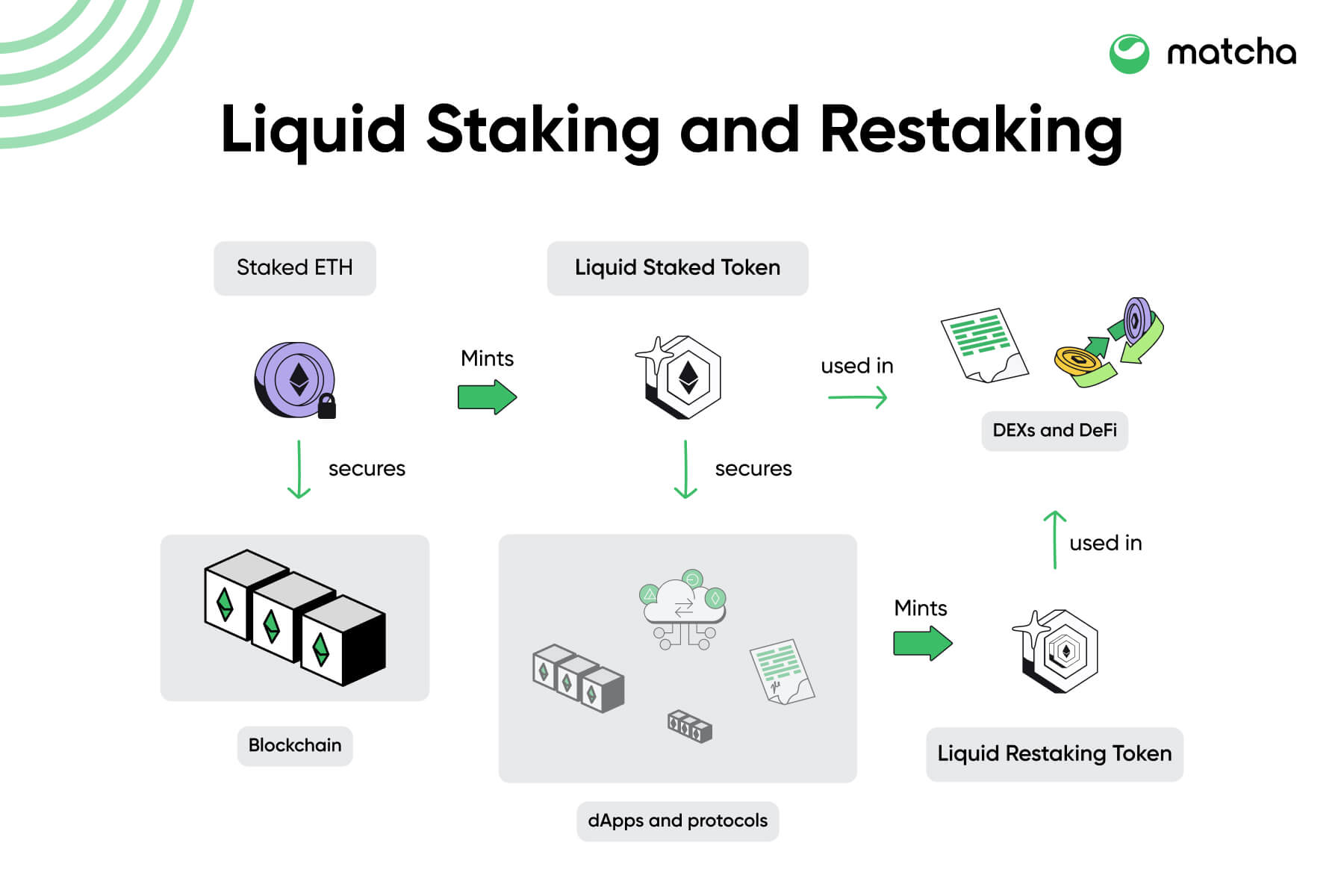
How LRTs redefine staked capital
Liquid restaking tokens (LRTs) represent a structural shift in how Ethereum capital is allocated. While standard liquid staking tokens (LSTs) like stETH or rETH simply tokenize staked ETH to maintain liquidity, LRTs introduce a second layer of utility. They allow users to take their already-staked ETH and delegate it again to secure additional decentralized services, known as Actively Validated Services (AVS). This process, often called "restaking," unlocks the security of ETH for new protocols without requiring new capital.
The mechanism works by re-delegating the validator keys and economic stake. When you hold an LRT, you are not just earning the base yield from Ethereum consensus; you are also earning additional yield from the AVSs your stake helps secure. This creates a compounding yield structure where the same ETH serves multiple functions simultaneously. According to analysis by Chainlink, this mechanism allows users to delegate staked assets to secure additional decentralized services, effectively monetizing security that was previously idle.
This re-use of capital changes the risk profile significantly. In standard staking, if a validator misbehaves, the penalty is limited to the staked ETH. In restaking, the same ETH backs multiple services. If one AVS fails or a validator is slashed, the penalty can cascade across all linked services. This multiplicative effect means that LRTs offer higher potential yields but carry a more complex risk landscape than traditional staking.
The financial implication is that LRTs transform staked ETH from a passive savings instrument into an active security provider. This redefinition is central to the 2026 landscape, where the demand for decentralized security is outpacing the supply of independent validators. By pooling and re-delegating stake, LRTs provide the necessary security depth for new infrastructure layers, from decentralized oracle networks to modular blockchain layers.
How LRTs Generate Yield
Liquid Restaking Tokens (LRTs) fundamentally alter capital efficiency by decoupling the security function of Ethereum from the yield generation process. When you stake ETH, you lock capital to secure the base layer. LRT protocols allow you to "restake" that same ETH, re-pledging it to secure additional protocols known as Actively Validated Services (AVS). This transforms a single unit of staked capital into a multi-layered security provider, unlocking yield streams that base staking alone cannot offer.
The yield composition for an LRT typically includes three distinct layers:
- Base ETH Staking Rewards: The foundational 3-4% APR paid by the Ethereum protocol for securing the chain. This is the risk-free (protocol-level) baseline.
- AVS Fees: Payments from specific AVSs for the computational or security services they require. For example, an AVS providing decentralized oracle services or data availability might pay in its native token or ETH.
- Protocol Incentives: Liquidity mining rewards or governance tokens distributed by the LRT protocol itself to attract capital and secure network health.
This layered approach creates a compounding effect. While base staking offers a static return, LRTs offer variable upside tied to the demand for specific AVS services. However, this efficiency comes with complexity. The yield is not guaranteed; it fluctuates based on AVS adoption, token emissions, and the specific risk profile of the services being secured.
The efficiency gain is most visible in portfolio construction. Instead of allocating separate capital for Ethereum security and DeFi yield farming, LRTs consolidate these functions. This reduces capital fragmentation and simplifies risk management. For 2026 portfolios, this means higher potential yield per unit of staked ETH, but it also requires careful monitoring of the underlying AVS risks. The yield is only as strong as the security guarantees provided by the AVSs it supports.
Protocol Comparison: Ether.fi, Renzo, and Kelp DAO
Evaluating liquid restaking tokens requires looking beyond headline yields. The three dominant protocols—Ether.fi, Renzo, and Kelp DAO—employ distinct strategies to generate returns and manage risk. Ether.fi focuses on native staking and diverse EigenLayer AVS integration. Renzo emphasizes composability and automated yield optimization. Kelp DAO prioritizes capital efficiency through its rETH and ezETH products.
The following table contrasts their core metrics and operational models. Data reflects current on-chain totals locked in each protocol.
| Protocol | Primary LRT | TVL Rank | Risk Model | Key Feature |
|---|---|---|---|---|
| Ether.fi | ETHx | 1 | Multi-Node, Native | Native Staking |
| Renzo | ezETH | 2 | Optimized, Liquid | Auto-Yield |
| Kelp DAO | ezETH | 3 | Delegated, Liquid | Capital Efficiency |
Ether.fi maintains the largest total value locked by anchoring its strategy in native ETH staking rather than relying solely on other liquid staking tokens. This approach minimizes double-counting risks but exposes users to the performance of the underlying Ethereum validators. Its integration with multiple Active Verification Services (AVSs) allows for diversified yield sources, though it increases the complexity of the security stack.
Renzo and Kelp DAO both utilize ezETH as a primary product, but their underlying mechanics differ. Renzo acts as a restaking index, automatically allocating capital to various AVSs to maximize yield while maintaining liquidity. Kelp DAO, through its rETH foundation, focuses on providing a more traditional liquid staking experience with an added restaking layer, appealing to users seeking simpler entry points into restaking.
When comparing these protocols, investors must weigh the trade-off between yield optimization and security complexity. Higher yields from multiple AVS integrations often correlate with increased smart contract and slashing risks. Diversification across protocols may mitigate single-point failures, but it also complicates position management.
Technical analysis of the underlying assets remains critical. The performance of these LRTs is heavily correlated with ETH price action and network activity. Monitoring the TechnicalChart for ETH provides context for the potential upside or downside of restaking yields, especially during periods of high volatility.
Assessing Smart Contract and Slashing Risks
Liquid restaking amplifies yield potential by layering staked assets across multiple Active Validator Services (AVS). This compounding mechanism introduces a complex risk topology that extends far beyond standard staking. The primary concern is not just protocol failure, but the cascading nature of liability when a single validator is slashed across multiple services simultaneously.
Smart Contract Vulnerabilities
LRT protocols rely on intricate smart contract architectures to manage deposit, withdrawal, and reward distribution. Each layer of abstraction—whether it is the LRT wrapper, the restaking operator, or the AVS contract—introduces potential attack surfaces. Bugs in these contracts can lead to total loss of principal. The risk is compounded by the fact that many LRT protocols are relatively new and have undergone less rigorous audit scrutiny than established Layer 1 chains.
Slashing events occur when validators behave maliciously or negligently, such as by double-signing or going offline. In a traditional staking setup, the penalty is limited to the staked ETH. In liquid restaking, a single slashing event on an AVS can trigger penalties across all restaked assets tied to that operator. This creates a "contagion effect" where one failure can drain the entire restaked position, not just the specific AVS allocation.
Impermanent Loss and Yield Volatility
While less discussed than slashing, impermanent loss remains a factor, particularly in protocols that utilize dynamic yield strategies or leverage. If the value of the LRT diverges significantly from the underlying ETH due to market fluctuations or yield differentials, early withdrawers may face reduced returns. This risk is acute during periods of high volatility, where the liquidity pool dynamics can shift rapidly.
To mitigate these risks, investors should prioritize protocols with robust insurance funds and slashing protection mechanisms. These funds act as a buffer, compensating users in the event of operator failure. Additionally, diversifying across multiple operators and AVSs can reduce the impact of a single point of failure. Always review the protocol's historical performance and audit reports before committing capital.
Risk Assessment Framework
When evaluating LRT protocols, consider the following risk dimensions:
- Audit History: Check for multiple independent audits and bug bounty programs.
- Operator Diversification: Assess how the protocol distributes stakes across multiple validators.
- Slashing Mitigation: Verify the presence of insurance funds or slashing protection mechanisms.
- Smart Contract Complexity: Prefer protocols with simpler, more transparent codebases.
- Yield Sustainability: Ensure yield claims are backed by real economic activity, not unsustainable token emissions.
Understanding these risks is critical for making informed decisions in the high-stakes environment of liquid restaking. Always conduct your own due diligence and consider consulting with financial advisors familiar with DeFi risks.
No comments yet. Be the first to share your thoughts!