
What restaking derivatives offer in 2026
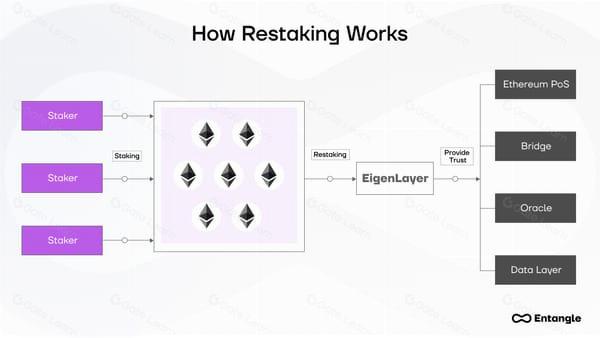
Restaking derivatives allow staked ETH to secure multiple networks simultaneously, generating a security premium on top of base staking yields. This mechanism shifts capital from single-purpose staking to a multi-layered efficiency model, where the same underlying asset provides cryptographic guarantees for various decentralized services.
In 2026, the sector has matured beyond experimental phases into a core component of DeFi infrastructure. Protocols like EigenLayer and Liquid Restaking Tokens (LRTs) now facilitate this shared security. Instead of locking capital for one validator role, stakers can delegate their security to Actively Validated Services (AVSs), earning additional yield for each network secured.
This structure creates a compounding yield environment. Base rewards from Ethereum consensus layer staking are augmented by fees from AVSs such as oracle networks, data availability layers, and decentralized compute markets. The total return is no longer static but scales with the demand for decentralized security across the broader ecosystem.
However, this efficiency introduces complex risk vectors. Smart contract vulnerabilities in restaking protocols or slashing conditions from AVSs can impact the entire staked position. Understanding these mechanics is essential for evaluating whether the added yield justifies the exposure to multi-layered smart contract risk.
How EigenLayer v2 Mechanics Enable Shared Security
EigenLayer v2 shifts restaking from a simple yield add-on to a foundational infrastructure layer for Ethereum. The core upgrade introduces a more robust mechanism for "shared security," allowing staked ETH to secure multiple networks simultaneously without requiring separate validator sets for each. This architectural change reduces the friction of deploying new rollups or sidechains, as they can lease security from the Ethereum mainnet rather than bootstrapping their own validator economy from scratch.
The technical implementation relies on updated slashing conditions and intent-based settlement layers. When a node operator restakes their ETH, they are essentially signing a contract that commits their stake to the security of these additional networks. If the node acts maliciously on any of the secured networks, it faces slashing penalties on its primary Ethereum stake. This creates a unified security pool where the cost of attacking a secondary network is tied to the value of Ethereum itself, significantly raising the barrier for bad actors.
This shared security model directly impacts yield decomposition. As of March 2026, Ethereum solo staking offers a base yield of approximately 2.8–3.2%.
Restaking protocols now layer a specialized "security premium" on top of this base yield. This premium is not speculative; it is the market price for the risk of slashing and the utility of securing other chains. Liquid Restaking Token (LRT) providers bundle these yields, offering users a composite return that reflects both the underlying staking reward and the fee generated by the secured networks. For high-stakes financial decisions, understanding this decomposition is critical: the yield is not free money, but compensation for providing a tangible security service to the broader Ethereum ecosystem.
Top liquid restaking tokens compared
Liquid restaking tokens (LRTs) have evolved from experimental yield aggregators into the backbone of restaking infrastructure. In 2026, the market is dominated by Ether.fi, Renzo, and Kelp, each offering distinct mechanics for decomposing yield and managing risk. Choosing the right LRT requires evaluating not just the headline APY, but the composition of that yield and the protocol's integration with broader DeFi markets.
The following table compares the core metrics of these leading protocols. Data reflects market conditions and protocol parameters as of early 2026.
| Protocol | Primary Token | TVL (USD) | Yield Source | Risk Profile |
|---|---|---|---|---|
| Ether.fi | eETH / ezETH | ~$1.2B | ETH Staking + Restaking Points | Moderate |
| Renzo | ezETH | ~$800M | ETH Staking + Restaking Rewards | Moderate |
| Kelp DAO | rsETH | ~$600M | ETH Staking + Restaking Yield | Conservative |
Ether.fi remains the largest LRT by total value locked, leveraging its dual-token model (eETH for pure staking yield, ezETH for restaking exposure) to capture significant market share. Its yield decomposition is transparent, splitting rewards between native ETH staking and restaking points, which are increasingly valuable as EigenLayer v2 matures.
Renzo offers a more streamlined single-token approach with ezETH, focusing on ease of use and deep liquidity across major decentralized exchanges. Its yield is derived from both base staking rewards and restaking incentives, often optimized through automated yield farming strategies. Renzo's risk profile is similar to Ether.fi but with less complexity for the end user.
Kelp DAO, through its rsETH token, emphasizes a conservative risk profile by carefully selecting restaking operators and focusing on sustainable yield rather than high-risk point farming. This approach appeals to institutional players and risk-averse retail investors who prioritize capital preservation alongside steady returns.
For real-time market data, including current prices and trading volumes, you can track these tokens using live widgets below. Always verify current TVL and yield metrics before making investment decisions, as these figures fluctuate daily.
Capital efficiency and yield decomposition
Restaking derivatives fundamentally alter capital efficiency by allowing a single unit of staked ETH to provide cryptographic guarantees for multiple networks simultaneously. Native Ethereum staking locks capital to secure the base layer alone. Restaking protocols like EigenLayer (v2) and Liquid Restaking Tokens (LRTs) separate the security service from the staking asset, enabling the same collateral to earn yield from diverse infrastructure layers.
The total yield from restaking is not a single monolithic rate but a sum of distinct components. The first layer is base ETH yield, derived from Ethereum block rewards and MEV (Maximal Extractable Value). This provides a floor return, typically ranging between 3% and 4% APY depending on network congestion and validator performance. This component is relatively stable and independent of restaking-specific risks.
The second layer is the security premium, paid by AVSs (Actively Validated Services) for the cryptographic guarantees provided by restakers. This varies by the risk profile and demand of each AVS. The third layer consists of LRT incentives, often distributed as governance tokens to bootstrap liquidity. As of late February 2026, the broader restaking sector holds approximately $13.45 billion in TVL, generating over $527,000 in daily yield from these combined sources [1].
This decomposition allows investors to isolate specific risk exposures. By choosing specific LRTs or direct restaking positions, capital allocators can optimize for the security premium or the base yield, rather than accepting a blended, opaque rate. This granularity is the primary driver behind the rapid adoption of restaking derivatives in 2026.
[1] https://daic.capital/blog/crypto-staking-trends-2026
Slashing risks and systemic exposure
Restaking amplifies yield by pooling security, but it concentrates risk in a single point of failure. If a node operator violates the protocol's consensus rules, the entire staked balance at risk can be slashed. Unlike simple staking, where only the specific stake is penalized, restaking exposes all assets secured by that operator across multiple networks. A single misconfiguration or malicious act can trigger cascading losses for EigenLayer and Liquid Restaking Token (LRT) providers alike.
Systemic exposure arises from the correlated nature of these positions. When multiple protocols rely on the same set of operators, a failure in one layer propagates to others. This creates a "too big to fail" dynamic where the health of the broader DeFi ecosystem becomes tethered to the performance of a few key validators. In 2026, as restaking TVL continues to grow, the potential for a domino effect increases, making risk management more critical than yield optimization.
Understanding these mechanics is essential for any participant. The yield derived from restaking is not free; it is compensation for assuming the risk of shared security failures. Protocols like EigenLayer v2 are working to mitigate these risks through improved slashing conditions and operator diversification, but the underlying correlation remains a fundamental feature of the model.
Frequently asked questions about restaking
For real-time performance context, you can monitor the current market status of the underlying assets below.
The mechanics of restaking are complex, but the data from early 2026 shows a clear trend: yield is no longer just about holding ETH, but about how efficiently that ETH is deployed across the ecosystem.
No comments yet. Be the first to share your thoughts!