
How restaking derivatives generate yield in 2026
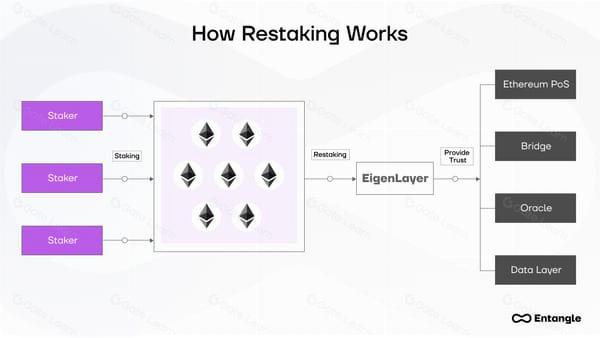
Restaking derivatives, often called Liquid Restaking Tokens (LRTs), function as a financial layer that reuses the security already provided to Ethereum. Instead of letting staked ETH sit idle after securing the base network, these protocols wrap your position and redeploy that same cryptographic proof to support additional services, such as oracle networks or bridge validators. This mechanism allows a single unit of collateral to secure multiple systems simultaneously.
The economic engine behind this model is the "security premium." While solo staking ETH currently offers a base yield of approximately 2.8% to 3.2%, LRTs add a secondary layer of compensation on top of that foundation. This premium represents the additional yield paid by secondary protocols to access the underlying security. It is the financial reward for taking on the extra responsibility of validating these auxiliary services.
By combining the base network yield with the security premium, restaking derivatives aim to deliver a higher total return than traditional staking. However, this increased yield comes with a corresponding increase in complexity and risk. The derivative token represents a claim on both the base staking rewards and the additional security payments, making its value directly tied to the health and demand of the secondary protocols it supports.
Comparing top liquid restaking protocols
Liquid restaking (LRT) protocols have become the primary infrastructure for deploying capital across multiple security layers. By tokenizing staked assets, these protocols allow holders to earn yield from both the base consensus layer and additional network services. The market is currently dominated by Ethereum-native solutions like EigenLayer and Jito, while Babylon has emerged as the leading protocol for Bitcoin restaking.
The choice between these protocols depends on your primary asset and risk tolerance. EigenLayer offers the deepest liquidity and highest total value locked (TVL) but introduces complex slashing risks across its growing ecosystem of Actively Validated Services (AVSs). Jito provides a streamlined experience for Solana users, focusing on MEV extraction and liquid staking derivatives. Babylon, meanwhile, unlocks Bitcoin’s dormant capital for DeFi applications without moving the underlying BTC from its native chain.
The table below compares the core metrics of these three major protocols as of early 2026. Note that TVL and yields fluctuate daily based on market conditions and network demand.
| Protocol | Primary Asset | Approx. TVL | Yield Source |
|---|---|---|---|
| EigenLayer | ETH | $12B+ | ETH Staking + AVS Fees |
| Jito | SOL | $2B+ | SOL Staking + MEV |
| Babylon | BTC | $1.5B+ | BTC Staking + DeFi Yields |
EigenLayer remains the largest player by a significant margin, leveraging Ethereum’s security to support a wide range of new protocols. Its yield comes from two sources: the base 3-4% ETH staking reward and variable fees from AVSs that rent EigenLayer’s security. This dual-yield structure can offer higher returns but requires users to understand the specific risks of each AVS they support.
Jito dominates the Solana liquid restaking space. Its primary yield driver is MEV (Maximal Extractable Value) rewards, which are distributed to Jito-SOL holders. This model has proven highly efficient, often outperforming traditional Solana staking yields. However, it is limited to the Solana ecosystem and does not support cross-chain restaking in the same way EigenLayer does.
Babylon represents a new category: Bitcoin restaking. It allows BTC holders to stake their coins for security while keeping them liquid via BabylonBTC tokens. These tokens can then be used in DeFi protocols to earn additional yield. This approach unlocks billions in dormant Bitcoin capital without requiring bridge-based solutions that carry their own risks.
Market Structure and Technical Outlook
Restaking derivatives track the technical structure of their underlying assets, primarily Ethereum (ETH). Because these tokens represent staked ETH plus additional yield accrual, their price action is heavily correlated with the base asset's momentum. Understanding the support and resistance levels on ETH is the first step in timing entries for liquid restaking tokens (LRTs).
The chart above highlights key technical levels for ETH/USD. When ETH consolidates near support, LRTs often offer a more attractive entry point for yield accumulation. Conversely, breakouts above resistance typically signal strong momentum, though they may also indicate overbought conditions depending on the RSI reading. Traders should watch volume spikes to confirm trend direction.
LRTs introduce a layer of complexity to this technical analysis. While they follow ETH's general trend, their premium or discount to net asset value (NAV) can fluctuate based on protocol-specific risk perceptions and yield rates. A strong ETH trend does not always guarantee proportional gains for every LRT if the underlying protocol faces smart contract or slashing risks. Monitor the spread between the LRT price and the staked ETH index to gauge market sentiment.
For Bitcoin restaking derivatives, the correlation is less direct as the ecosystem is newer. However, the same principles apply: track BTC's macro structure and monitor the specific protocol's adoption metrics. Technical analysis for BTC-based LRTs often requires looking at trading volume and liquidity depth, as these markets are thinner and more prone to volatility.
Use the technical outlook as a guide, not a guarantee. Restaking involves smart contract risk that can decouple price action from traditional technical indicators. Always verify the health of the underlying protocol before entering a position based solely on chart patterns.
Regulatory shifts and systemic risk factors
The restaking economy is expanding rapidly, but it remains a high-stakes environment defined by two distinct threats: regulatory ambiguity and technical fragility. Unlike traditional finance, where capital controls and insurance frameworks provide clear boundaries, restaking derivatives operate in a gray zone. This uncertainty creates a volatile landscape where a single policy shift or code exploit can cascade across multiple protocols simultaneously.
Regulatory uncertainty
The primary regulatory hurdle for restaking derivatives is the classification of the underlying assets. In the United States, the Securities and Exchange Commission (SEC) and the Commodity Futures Trading Commission (CFTC) have yet to establish a unified framework for restaked assets. This lack of clarity forces protocols to navigate a patchwork of state-level regulations and federal enforcement actions.
For investors, this means that the legal standing of restaking yields is not guaranteed. If regulators classify restaked tokens as unregistered securities, trading volumes could plummet, and liquidity providers might face immediate restrictions. The market is currently pricing in this risk, but a definitive regulatory stance could trigger significant repricing events. Until then, participants are operating without the legal safeguards present in traditional banking.
Technical risks: Slashing and smart contracts
Beyond regulation, the technical architecture of restaking introduces unique systemic risks. Restaking allows validators to secure multiple networks simultaneously, which amplifies both yield and exposure. The most critical technical risk is slashing. If a validator behaves maliciously or fails to perform, the penalty is deducted from their staked assets. In a restaking context, this penalty can affect all the protocols the validator is securing, leading to correlated losses.
This correlation is the core danger of the current model. A failure in one major protocol can drain liquidity from others that share the same validator set. Additionally, smart contract risk remains a constant threat. Restaking protocols rely on complex code to manage lock-ups and reward distributions. Bugs or vulnerabilities in these contracts can lead to total loss of funds, as seen in previous DeFi exploits.
Mitigating exposure
To navigate these risks, investors must look beyond yield APYs and examine the underlying validator set and smart contract audits. Diversifying across non-correlated validator sets can reduce the impact of a single slashing event. Staying informed about regulatory developments is essential, as policy changes can alter the viability of certain protocols overnight.
The restaking sector is still in its formative period, as noted by industry analysts. While it offers significant yield opportunities, it requires a higher degree of technical diligence and risk tolerance than traditional staking. Participants should treat restaking derivatives as high-risk instruments, suitable only for those who understand the potential for correlated failures and regulatory shifts.
No comments yet. Be the first to share your thoughts!